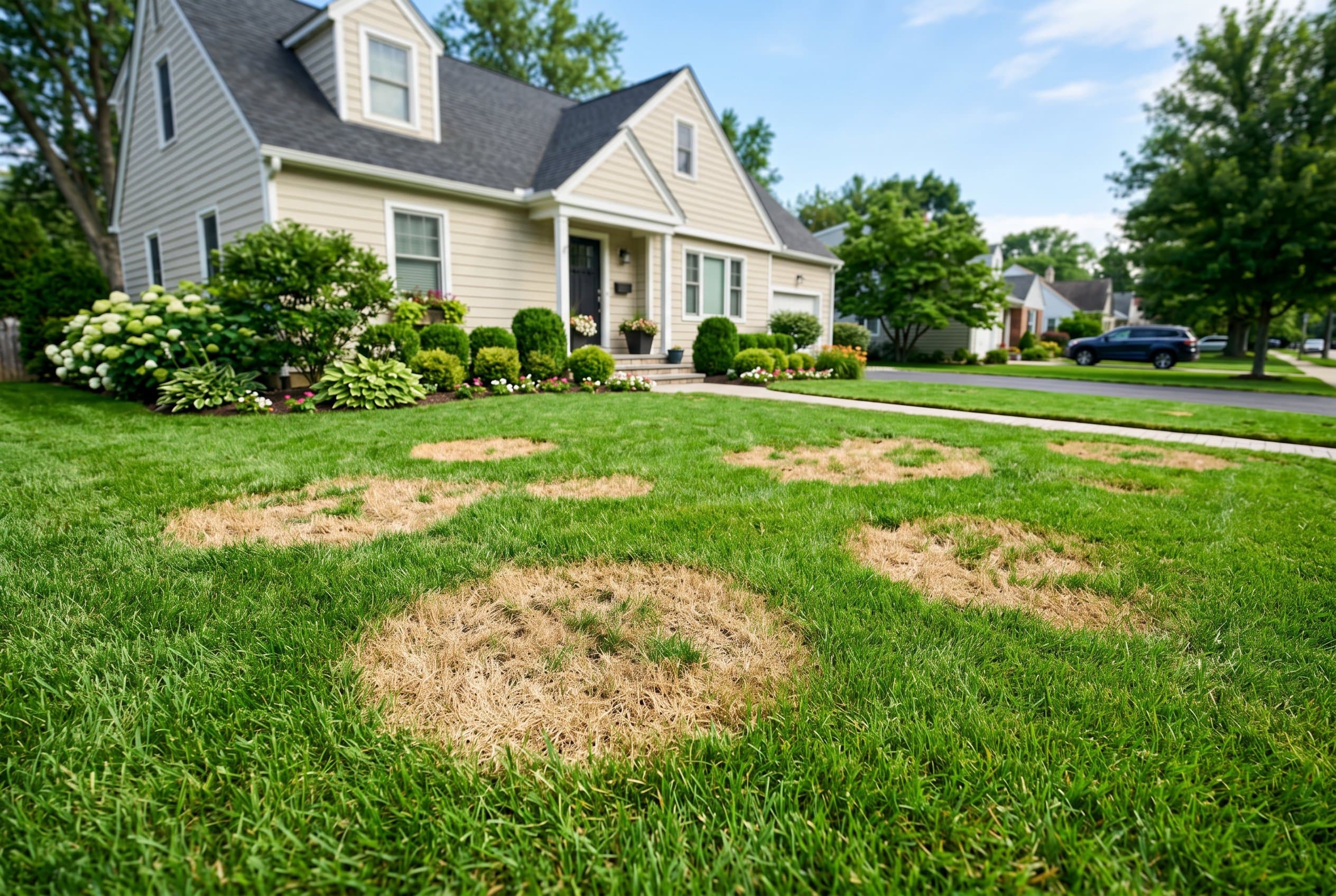
Quick Answer: Most summer lawn diseases can be told apart by three clues: the shape of the dead area (circle, ring, streak, or scattered spots), the lesions on individual grass blades, and the weather that triggered them. Brown patch leaves a smoke ring, dollar spot leaves hourglass-shaped bleached lesions, pythium leaves greasy streaks, summer patch leaves a green tuft inside a dead ring, gray leaf spot leaves gray-purple leaf spots, rust leaves orange dust, and fairy ring leaves a dark-green circle. Nail the ID first, rule out drought stress and grubs, then treat.
Key Takeaways
- Summer diseases switch on with warm nights and long leaf wetness — night temps above ~65°F plus 9-14 hours of dew or humidity are the common trigger.
- The single most useful diagnostic is the leaf lesion: check individual blades with a hand lens before you judge the patch.
- Cool-season lawns (tall fescue, bluegrass, ryegrass) get brown patch, pythium, and summer patch; warm-season and transition lawns get gray leaf spot and dollar spot.
- Drought stress and grub damage mimic disease — always rule those out before spraying a fungicide.
- Correcting watering, mowing, and nitrogen fixes most foliar diseases; only fast or root-based diseases need immediate chemical control.
Brown Patch
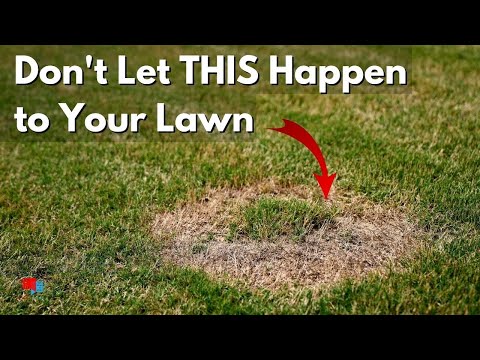
What it looks like: Roughly circular patches of tan, blighted turf ranging from about 5 inches to more than 10 feet across[1]. Early in the morning, look for a thin, darker "smoke ring" of gray-purple growth around the outer edge — the clearest signature of this disease[1]. Individual blades show irregular tan lesions with darker borders.
When it strikes: Daytime highs above 80°F, nighttime temperatures above 60°F, and more than 10 hours of leaf wetness for several days running[1]. Evening watering and excess nitrogen make it worse.
Grasses affected: Cool-season lawns, with turf-type tall fescue the most likely host[2]. (The warm-season version is called large patch.)
What to do: Water in the early morning only, ease off nitrogen, and improve airflow. For repair and fungicide options, see our guide on how to fix brown patches in lawn.
Dollar Spot
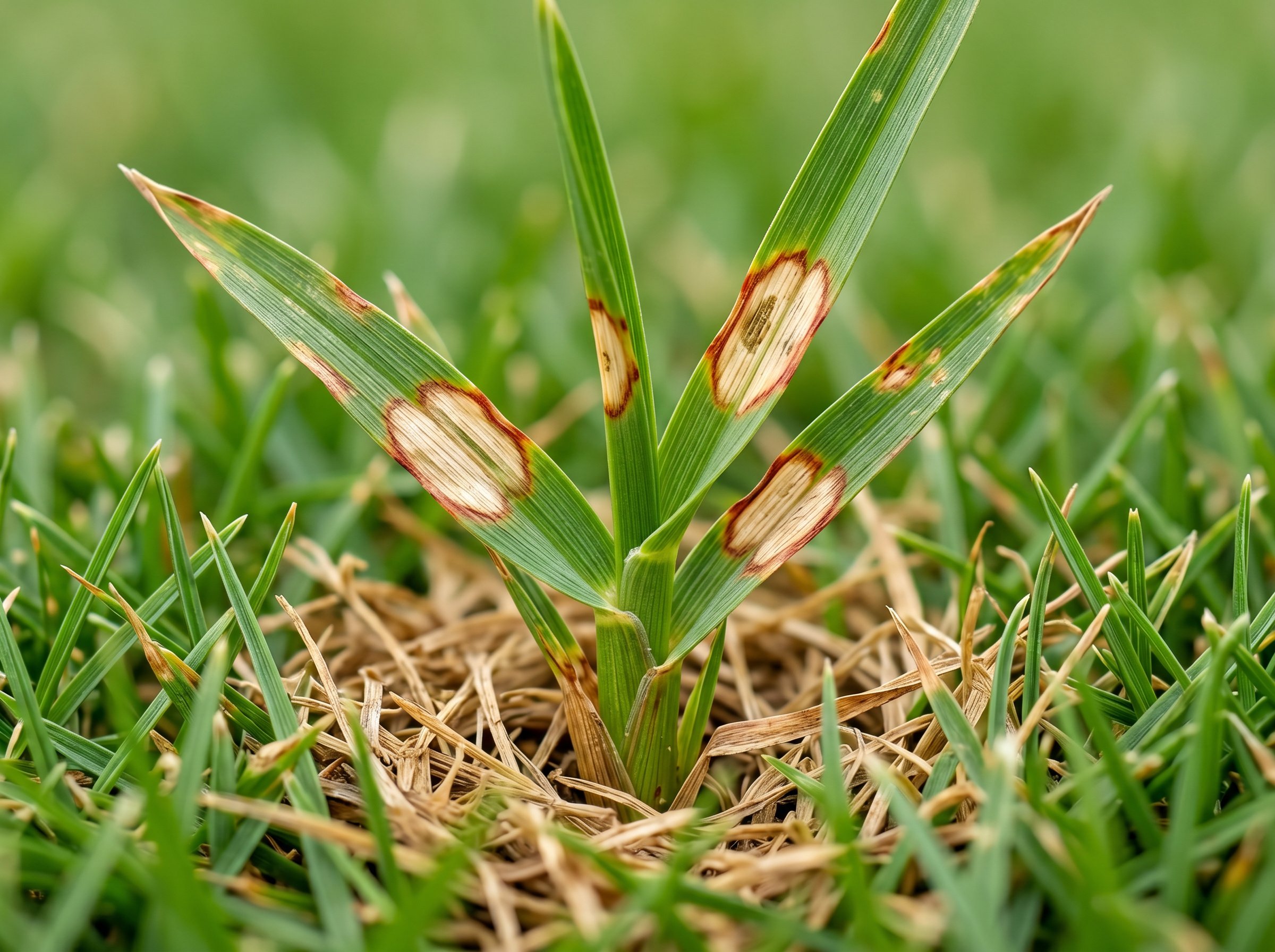
What it looks like: Small, sunken, straw-colored patches about 2-6 inches across that can merge into larger blighted areas[3]. On individual blades, the giveaway is an hourglass-shaped bleached band that spans the width of the leaf, edged with a reddish-brown border[3]. In heavy morning dew you may see fine white cottony mycelium[1].
When it strikes: Temperatures of 60-85°F with warm days, cool nights, and heavy dew[1]. Low soil nitrogen makes lawns more susceptible.
Grasses affected: Nearly all species, including tall fescue, ryegrass, bermudagrass, and zoysia[3].
What to do: A light nitrogen feeding often outgrows dollar spot, and morning watering reduces the dew window. If you decide to spray, get the timing right with our fungicide application timing guide.
Pythium Blight
What it looks like: Small reddish-brown or dark spots, roughly 1-6 inches across, that spread fast[4]. In the morning the grass looks water-soaked, dark, and slimy, often with a purplish-gray or white cottony mycelium on the outer margins[4]. The tell is the pattern: pythium follows drainage, mowing lines, and foot traffic, so it forms greasy streaks rather than clean circles, and it can collapse turf overnight[4].
When it strikes: Daytime highs of 85-95°F, nighttime lows of 68°F or higher, and at least 9 hours of relative humidity above 90%[4]. Poorly drained, low-lying, or overwatered areas go first.
Grasses affected: Cool-season grasses — perennial ryegrass, tall fescue, bentgrass, bluegrass, and fine fescue[4].
What to do: This is the one summer disease that warrants urgency because it kills so quickly. Stop evening watering immediately, improve drainage, and stay off wet, infected turf to avoid spreading it. Fungicide timing matters — read fungicide before or after mowing so you do not track spores across the lawn.
Summer Patch
What it looks like: Circular patches that start under 4 inches and expand to 4-18 inches, often coalescing into rings and crescents[5]. The classic frog-eye signature is a tuft of seemingly healthy green grass in the center of a dead ring[5]. Because it is a root-and-crown rot, affected plants yellow, then brown, and pull up easily with rotted roots.
When it strikes: Extended periods above 82°F following rainy spells, especially on compacted, poorly drained, or closely mowed turf[5]. Symptoms appear in mid-to-late summer even though root infection began earlier.
Grasses affected: Kentucky bluegrass, annual bluegrass, and fine fescues; perennial ryegrass and tall fescue resist it[5].
What to do: Raise your mowing height, relieve compaction with aeration, and water deeply but infrequently. Because the damage is at the roots, recovery is slow and preventive fungicides must go down before symptoms show.
Gray Leaf Spot
What it looks like: Small brown spots that enlarge rapidly into oblong lesions about a quarter inch long, tan-to-gray in the center with distinct purple-to-brown borders[1]. During active spore production the blades can take on a velvety gray cast, and severe outbreaks make a lawn look scorched.
When it strikes: Daytime temperatures of 80-90°F, nighttime temperatures above 65°F, and extended hot, rainy, humid weather — high nitrogen makes it worse[1].
Grasses affected: St. Augustinegrass and perennial ryegrass are hit hardest, with tall fescue, bermudagrass, and centipede also susceptible[1].
What to do: Back off nitrogen during hot, wet stretches and water in the morning. Perennial ryegrass can decline quickly, so on high-value lawns a preventive fungicide during peak heat is worth considering — see our fungicide timing guide.
Rust
What it looks like: Light-yellow flecks on blades and sheaths that enlarge into raised orange-to-reddish-brown pustules[6]. The unmistakable test: walk across the lawn and check your shoes — rust spores rub off as an orange-brown powder on shoes, mower tires, and pant legs.
When it strikes: Warm, humid conditions around 65-85°F, made worse by slow growth from low nitrogen, drought stress, or shade[6].
Grasses affected: Kentucky bluegrass, perennial ryegrass, tall fescue, and zoysiagrass[6].
What to do: Rust is rarely serious. A light nitrogen feeding to push new growth, plus regular mowing to remove infected tissue, usually clears it without fungicide.
Fairy Ring
What it looks like: A circular or arcing band of darker, faster-growing green grass, often 4-8 inches (10-20 cm) wide, sometimes with mushrooms after rain[6]. Some rings develop a zone of thin or dead grass just inside the green band. It is caused by soil fungi feeding on buried organic matter, not by an infection of the grass itself.
When it strikes: Warm, moist conditions and abundant rain, especially where there is buried wood, old roots, or heavy thatch feeding the fungi[6].
Grasses affected: All species[6].
What to do: Fairy ring is mostly cosmetic. Mask the dark-green ring with a balanced nitrogen feeding across the whole lawn, core aerate to improve water penetration in dry zones, and keep the area consistently watered.
Disease or Something Else?
Not every dead patch is a fungus. Two look-alikes cause the most false alarms:
Drought stress vs. disease. Drought shows a logical map — the crown of a slope, strips the sprinkler misses, the strip along a hot driveway. It appears blue-gray before it browns, and it greens up within a day of a deep soak. Disease ignores that logic: it forms defined circles, rings, or scattered spots, leaves distinct lesions on blades, and does not bounce back from watering. If a "patch" recovers overnight after irrigation, it was thirst, not fungus. For the full differential on discolored turf, see what causes yellow spots in grass.
Grub damage vs. fungus. Grubs sever roots, so damaged turf lifts up like a loose carpet or rolls back when you tug it — diseased grass stays anchored. Grub-damaged areas are often irregular and spongy underfoot, and you can dig at the edge to find C-shaped white larvae in the top few inches of soil. Skunk or bird digging is another tell. Compare the signs in grub vs. sod webworm, and if you confirm grubs, choose a product with our best grub killer for lawns guide.
The single most reliable step across all of these: get down on your knees with a hand lens and inspect individual blades at the edge of the damage, where you will find fresh lesions rather than fully collapsed tissue.
Quick-Reference Table
| Disease | Patch shape | Blade lesion | Peak conditions | Grasses |
|---|---|---|---|---|
| Brown patch | Circles, 5 in-10+ ft, smoke ring | Tan, dark border | Night >60°F, 10+ hr wet | Cool-season, tall fescue |
| Dollar spot | Silver-dollar spots, 2-6 in | Hourglass bleach band | 60-85°F, heavy dew | Nearly all |
| Pythium blight | Greasy streaks, 1-6 in | Water-soaked, slimy | 85-95°F, night >68°F | Cool-season |
| Summer patch | Rings with green center tuft | Rotted roots | >82°F after rain | Bluegrass, fine fescue |
| Gray leaf spot | Scorched areas | Gray center, purple border | 80-90°F, night >65°F | St. Augustine, ryegrass |
| Rust | Thin, yellowed turf | Orange powder pustules | 65-85°F, low N/shade | Bluegrass, ryegrass, zoysia |
| Fairy ring | Dark-green ring/arc | None (soil fungi) | Warm, moist, buried debris | All |
The Bottom Line
Summer diseases look alike from a distance but each leaves a distinct fingerprint on individual grass blades and in the shape of the damage. Confirm the pattern, rule out drought stress and grubs, then match your response to the threat — most foliar diseases fade once you fix watering, mowing, and fertility, while pythium and summer patch call for faster action. When you are ready to treat, our brown patch, fungicide timing, and grub control guides walk through each next step.