By the Lawn Care Center editorial team — updated May 2026
White grubs — the C-shaped larvae of Japanese beetles, masked chafers, and June beetles — are the most common culprit behind unexplained brown patches in otherwise healthy lawns. By the time skunks and raccoons start digging at night, the damage is already done at the root line, and the patches you see today usually get worse before they get better.
The right product depends on two things: whether the grubs are already feeding, and how big your treatment area is. This guide compares four widely available, consumer-grade grub control treatments you can buy on Amazon, with the active ingredient, treatment window, and coverage for each. Product selections are based on each product's label specifications, the active-ingredient class and its documented efficacy in university-extension research, and how each product fits the typical homeowner's situation. We do not run our own kill-rate trials; the science cited in this guide is sourced from MSU Extension[1], Purdue Turfgrass Science, and peer-reviewed turfgrass entomology.[2]
For timing — when to put any of these down for your climate — see our hub guide on when to apply grub killer.
Quick Picks
| Product | Best for | Buy |
|---|---|---|
| Scotts GrubEx1 Season Long | Season-long prevention | Buy on Amazon → |
| BioAdvanced 24 Hour Grub Killer Plus | Active grubs right now | Buy on Amazon → |
| BioAdvanced Complete Insect Killer | Grubs + surface insects in one pass | Buy on Amazon → |
| Spectracide Triazicide Granules | Budget / small lawns | Buy on Amazon → |
Do You Actually Have Grubs? A 60-Second Diagnosis
Before spending $30–$100 on grub control, confirm that grubs are actually your problem. Healthy turf can tolerate 4–7 grubs per square foot without visible damage. Treatment is warranted only above the economic threshold — and brown patches in summer have several causes (drought, disease, chinch bugs) that look identical from the surface.
The cut-and-count test:
- Select a patch at the edge of the damaged area (not the center — grubs move outward as they feed).
- Using a flat spade, cut a square roughly 12" × 12" and fold back the turf about 3 inches deep.
- Count all white, C-shaped larvae in the exposed soil and root zone.
- Repeat in 2–3 spots to get an average.
Action thresholds:
| Grub species | Treatment threshold |
|---|---|
| Japanese beetle, masked chafer | 8–10 per sq ft (most US) |
| European chafer (upper Midwest / northeast) | 3–5 per sq ft (more damaging per grub) |
| June beetle / May beetle | 3–5 per sq ft (three-year life cycle; fewer grubs but larger) |
Below the threshold, a healthy lawn can outcompete the damage through normal watering and fertilization.
Indirect signs: Spongy turf that rolls back like a rug (severed roots), raccoon/skunk digging overnight, birds pecking at the same spots repeatedly, dead turf patches that don't respond to water. Any of these alongside 8+ grubs in a cut-and-count confirms an infestation.
If your count comes back under the threshold, skip the insecticide — is your lawn problem grubs or something else? covers the differential against sod webworms, chinch bugs, and the environmental issues that mimic grub damage. Once you've ruled the other pests out and confirmed the patches are grub-caused, our hub on when to apply grub killer walks the calendar window by region.
Grub Control: Preventer vs. Curative — Pick This First
Every consumer grub-killer is either a preventer or a curative, and using the wrong one wastes your money.
- Preventers (chlorantraniliprole, imidacloprid) are applied before grubs hatch and start feeding — generally late spring through early summer in most US lawns. They sit in the top inch of soil for weeks and kill newly hatched grubs before they cause damage. They do not reliably kill the large, late-summer grubs you'd dig up in August.
- Curatives (trichlorfon, gamma-cyhalothrin) are designed to kill active grubs that are already feeding — usually late summer into fall when the damage shows. They act fast (some within 24–72 hours) but the residual is short.
If you see grubs in the soil right now and the damage is spreading, you need a curative. If you treated last year, lost grass, and want to stop a repeat, you need a preventer applied in spring or early summer.
The 4 best grub killers for lawns in 2026
The list below is ordered by how well each product fits the most common homeowner situation. Active ingredients reflect each product's label at time of writing — manufacturers do reformulate, so confirm the current label before you buy.
1. Scotts GrubEx1 Season Long Grub Killer — best preventer
- Active ingredient: chlorantraniliprole
- Treatment window: preventer (apply before grubs hatch)
- Coverage: 10,000 sq ft (14.35 lb bag); 5,000 sq ft (5 lb bag)
- Price band: $$
GrubEx is the default recommendation for a homeowner who wants one-and-done seasonal protection. Chlorantraniliprole is the lowest-toxicity active ingredient in the consumer grub-killer category, with a long residual that keeps working for months when applied early. The trade-off: it is not a fast knockdown. If you already see grubs feeding, this is the wrong product.
Pros:
- Lowest acute-toxicity profile of the four
- Long residual — typically a single application covers the season
- Two bag sizes for small vs. average lawns
Cons:
- Will not reliably kill large, late-summer grubs already in the soil
- Higher up-front cost per bag than budget options
Apply if: you want season-long prevention, you treated for grubs last year, or your neighborhood has chronic Japanese beetle pressure.
Buy Scotts GrubEx1 on Amazon →
2. BioAdvanced 24 Hour Grub Killer Plus — best curative
- Active ingredient: trichlorfon
- Treatment window: curative (kills active grubs)
- Coverage: 10,000 sq ft (10 lb bag)
- Price band: $$
Trichlorfon is the standard curative active ingredient for active grub infestations. It moves quickly into the root zone after watering and kills feeding grubs within a few days. Residual is short — this is a "you have grubs now, kill them now" product, not a seasonal preventer. Trichlorfon is more acutely toxic than chlorantraniliprole, so follow the label's pet and pollinator re-entry instructions carefully.
Pros:
- Fast knockdown of large, feeding grubs (24–72 hours after watering in)
- Strong fit for late-summer or fall rescue treatments
- Single-bag coverage matches most suburban lots
Cons:
- Short residual — not a season-long product
- Higher acute toxicity; stricter re-entry window for pets and kids
Apply if: you've dug a square foot of damaged turf and counted 8+ grubs (the standard action threshold), the damage is actively spreading, or August/September is here and you missed the preventer window.
Buy BioAdvanced 24 Hour Grub Killer Plus on Amazon →
3. BioAdvanced Complete Insect Killer for Lawns — best dual-purpose
- Active ingredient: imidacloprid + β-cyfluthrin (per current label)
- Treatment window: early-curative + surface-pest control
- Coverage: 10,000 sq ft (10 lb bag)
- Price band: $$
Complete Insect Killer occupies the middle ground. Imidacloprid provides systemic grub control for newly hatched larvae, while β-cyfluthrin handles surface pests like ants, chinch bugs, and sod webworms in the same pass. It is less of a preventer than GrubEx (shorter residual) and less of a curative than trichlorfon (slower against large grubs), but if you have mixed pest pressure, it saves a second product. Imidacloprid is under ongoing regulatory scrutiny in some states — check local restrictions before buying.
Pros:
- Covers grubs and surface insects in one application
- Useful when chinch bugs or sod webworms are also pressuring the lawn
- Reasonable residual against early-season pests
Cons:
- Not the best at either job — neither a true season-long preventer nor a fast curative
- Imidacloprid is restricted or scrutinized in some jurisdictions
Apply if: you want one product covering grubs plus surface insects, or you have early-season pest pressure across multiple insects.
Buy BioAdvanced Complete Insect Killer on Amazon →
4. Spectracide Triazicide Insect Killer for Lawns Granules — best budget broad-spectrum
- Active ingredient: gamma-cyhalothrin
- Treatment window: curative (broad-spectrum)
- Coverage: 10,000 sq ft (10 lb bag)
- Price band: $
Triazicide is the budget option. It is a contact insecticide — it knocks down grubs and surface pests it reaches, but it does not have the systemic activity of imidacloprid or the long residual of chlorantraniliprole. Most useful on a small lawn (<5,000 sq ft), a one-time knockdown when the budget is tight, or as a curative on a confirmed light grub population.
Pros:
- Lowest cost-per-bag of the four
- Broad-spectrum — handles surface pests alongside grubs
- Easy to find at any big-box retailer if Amazon shipping is slow
Cons:
- No systemic activity — kills only what the product physically reaches
- Short residual; may need a follow-up application
Apply if: budget is the constraint, your lawn is small, or you need a quick contact-kill on confirmed light grub pressure.
Buy Spectracide Triazicide on Amazon →
At-a-glance comparison
| Product | Active ingredient | Window | Coverage | Price band |
|---|---|---|---|---|
| Scotts GrubEx1 Season Long Grub Killer | chlorantraniliprole | preventer | 5,000 / 10,000 sq ft | $$ |
| BioAdvanced 24 Hour Grub Killer Plus | trichlorfon | curative | 10,000 sq ft | $$ |
| BioAdvanced Complete Insect Killer for Lawns | imidacloprid + β-cyfluthrin | early-curative + surface | 10,000 sq ft | $$ |
| Spectracide Triazicide Granules | gamma-cyhalothrin | curative (broad) | 10,000 sq ft | $ |
Active Ingredients, Decoded
Not all "grub killers" work the same way. The active ingredient determines the treatment window, the target life stage, and whether you're preventing damage or rescuing a lawn that's already been eaten. Understanding this before you buy saves a wasted application.
| Active Ingredient | Class | Best window | Target | Residual | Products |
|---|---|---|---|---|---|
| **Chlorantraniliprole** | Diamide | Preventer — April through mid-July | Newly hatched 1st/2nd instar | Long (3–4 months) | Scotts GrubEx1, others |
| **Imidacloprid** | Neonicotinoid | Preventer — May through July | 1st/2nd instar grubs | Medium (6–8 weeks) | BioAdvanced Complete (with β-cyfluthrin), Grub-B-Gon |
| **Thiamethoxam** | Neonicotinoid | Preventer — May through July | 1st/2nd instar grubs | Medium | Some Merit formulations |
| **Clothianidin** | Neonicotinoid | Preventer + limited curative | Young to mid-stage grubs | Medium–long | Arena, some professional products |
| **Trichlorfon** | Organophosphate | Curative — August through October | All instars; fast knockdown | Short (1–2 weeks) | BioAdvanced 24 Hour Grub Killer Plus |
| **Halofenozide** | Ecdysone agonist | Curative — summer / early fall | Grubs specifically (insect molting hormone) | Medium | Mach 2 (less widely available) |
Key practical takeaways:
- Chlorantraniliprole (GrubEx) is the most forgiving — it has the longest residual and the lowest acute toxicity. If you apply it 2–4 weeks before hatching, it provides season-long protection.
- Trichlorfon is the only true fast curative available over the counter at the required action threshold timing (late summer). It works on large grubs that imidacloprid has missed.
- Imidacloprid is a preventer, not a curative. Many homeowners apply BioAdvanced Complete in August expecting it to kill large grubs; the imidacloprid does little at that stage. The β-cyfluthrin in BioAdvanced Complete handles surface pests, not root-zone grubs.
- Pyrethroid-only products do not effectively control soil-feeding grubs — see the next section.
For the MSU Extension active-ingredient comparison with detailed application timing by zone, see the grub-control timing guide.
Insecticides That Won't Work for Grubs
This is the section that most product roundups skip, and it is why so many homeowners treat their lawn and see no improvement.
Pyrethroids do not control grubs. Lambda-cyhalothrin, bifenthrin, deltamethrin, cyfluthrin, permethrin, and gamma-cyhalothrin (the active ingredient in Spectracide Triazicide) are highly effective against surface-feeding insects — ants, chinch bugs, sod webworms, ticks. But they bind tightly to soil organic matter and thatch on contact and do not move down to the root zone 2–4 inches below the surface where white grubs feed.[3]
MSU Extension calls pyrethroids "ineffective" specifically for white grub control. If you've applied a pyrethroid lawn insecticide and your grubs survived, that's why.
Practical implication: Spectracide Triazicide, Ortho Bug B-Gon, and similar products built on pyrethroid active ingredients are useful lawn insecticides — just not for grubs. If you're treating for grubs, look at the active ingredient. If it ends in "-thrin" or contains "pyrethrin/pyrethroid" on the label, set it aside for a different pest problem.
What about "combination" products? Some products advertise both grub control and surface pest control. BioAdvanced Complete Insect Killer combines imidacloprid (grub-active) with β-cyfluthrin (pyrethroid, surface-active). The imidacloprid does the grub work; the β-cyfluthrin handles surface pests. This is not "both active on grubs" — it is two separate modes of action for two separate pest groups.
Which Grub Control Products Also Handle Ants, Fleas, Ticks, and Chinch Bugs?
Two of the four products above are grub specialists; the other two are registered as broader lawn insecticides. Here's what each product's own EPA-registered label claims — not marketing copy — so you don't buy a dedicated grub treatment expecting flea or tick control it doesn't have, or overlook one that already covers a second pest problem.
| Product | Also labeled for | Not labeled for |
|---|---|---|
| Scotts GrubEx1 (chlorantraniliprole) | Chinch bugs, billbugs, armyworms, cutworms, crane fly larvae[[4]](#user-content-fn-4) | Ants, fleas, ticks |
| BioAdvanced 24 Hour Grub Killer Plus (trichlorfon) | Chinch bugs, ticks, most ants (excludes carpenter, fire, harvester, and pharaoh ants), armyworms, billbugs, crickets, sod webworms[[5]](#user-content-fn-5) | Fleas |
| BioAdvanced Complete Insect Killer for Lawns (imidacloprid + β-cyfluthrin) | Ants, fleas, ticks, chinch bugs, mole crickets, European crane fly larvae[[6]](#user-content-fn-6) | — |
| Spectracide Triazicide Granules (gamma-cyhalothrin) | Fleas, ticks, chinch bugs, fire ants (excludes pharaoh and harvester ants), crickets, armyworms[[7]](#user-content-fn-7) | — |
If you're also fighting ants, fleas, ticks, or chinch bugs: BioAdvanced Complete and Spectracide Triazicide are the two products here that double as general lawn-pest control. Pick Complete if grubs are the main concern and surface pests are secondary — the imidacloprid still does real systemic work on young grubs. Pick Triazicide if the grubs are incidental and ants, fleas, or ticks are the actual target, since its contact-only mode of action (covered above) doesn't reach grubs feeding at root depth anyway. GrubEx1 and 24 Hour Grub Killer Plus are grub specialists first: 24 Hour Grub Killer Plus's label happens to cover ticks and most ant species as a side effect of trichlorfon's broad-spectrum mode of action, but neither product is formulated or priced as a dedicated flea/tick/ant treatment. Labels change between reformulations, so confirm the pest list on the bag before relying on any of these four for something other than grubs.
Timing by Life-Cycle Stage
Applying the right product at the wrong time is the most common grub-treatment failure. Here is the Japanese beetle / masked chafer life cycle with the corresponding application window for each product class.
| Month | Life-cycle stage | Preventers (chlorantraniliprole, imidacloprid) | Curative (trichlorfon) |
|---|---|---|---|
| April–May | Overwintering grubs resume spring feeding (limited); pupation begins | Too late for preventers — grubs are 3rd instar | Possible but poor ROI; grubs near pupation |
| June–early July | Adults emerge, begin flight; egg-laying begins | **Best preventer window opens** — apply before eggs hatch | Not yet needed |
| Mid-July–August | Eggs hatch; 1st–2nd instar grubs start feeding near surface | **Peak preventer window** — chlorantraniliprole in soil; grubs encounter it as they hatch | Curatives begin to be effective on young grubs |
| August–September | 2nd–3rd instar feeding peak; heaviest damage visible | Preventers lose efficacy on large grubs | **Peak curative window** — trichlorfon on feeding 3rd instar |
| September–October | Grubs migrate deeper (6"+) as soil cools | Not effective | **Last reliable curative window** — water-in before soil drops below 50°F |
| November–March | Dormant deep in soil; not feeding | No treatment | No treatment (grubs unreachable) |
The "stop curative" deadline: Do not apply trichlorfon after mid-October in most US climates. Grubs have moved below 6 inches and will not encounter the product before winter dormancy.
The spring application trap: some homeowners apply grub control in April or May when they notice the damage from the previous season. This is largely wasted — overwintering 3rd instar grubs are near pupation, barely feeding, and will naturally die off shortly as adults emerge.
How to Apply Granular Grub Killer
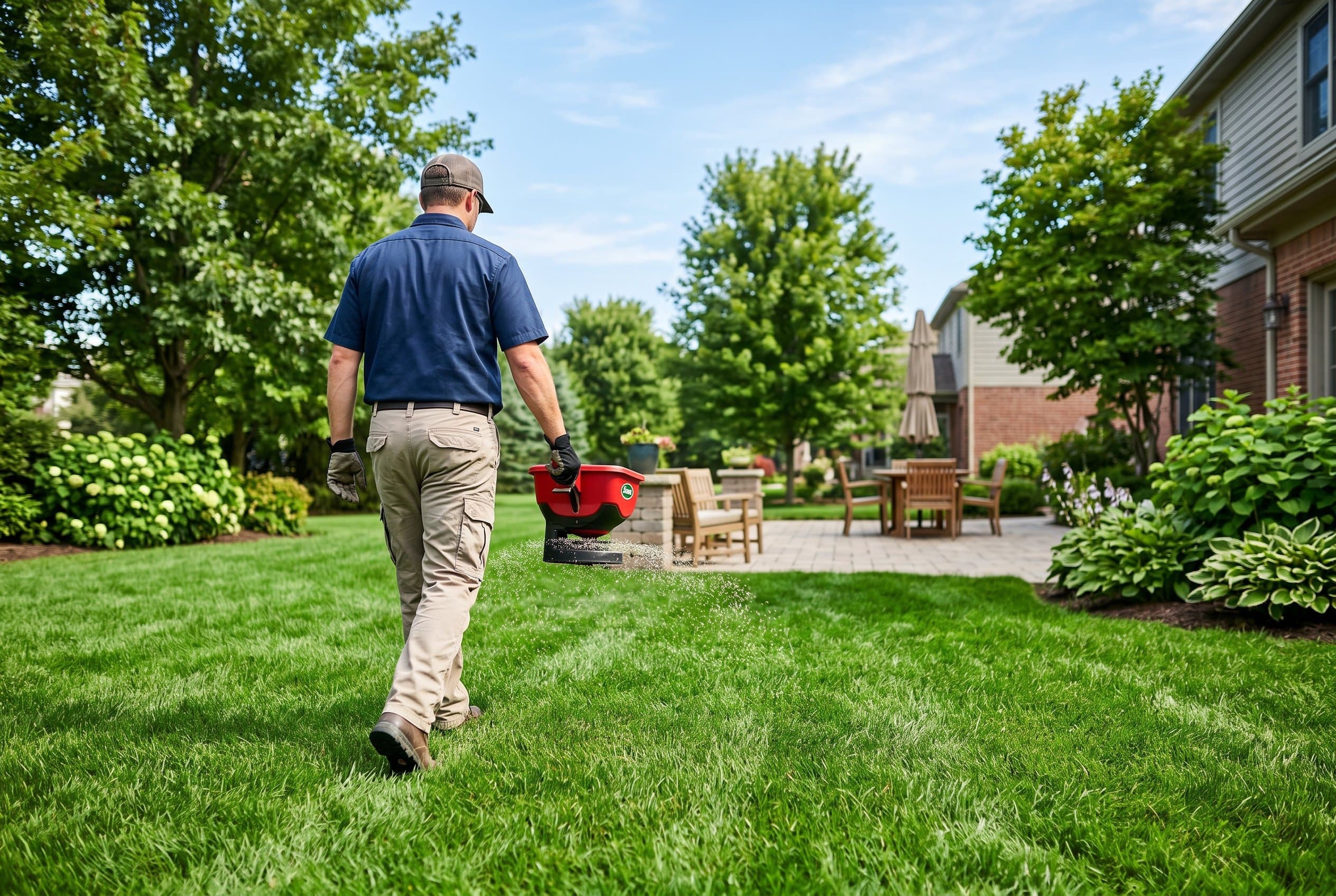
Application is roughly the same across all four products — the timing is what varies. The short version:
- Mow your lawn before application so granules can reach the soil surface.
- Use a broadcast or drop spreader set to the label's specified setting. Do not eyeball it. Under-applying wastes the product; over-applying wastes money and can damage the turf. Calibrate your spreader setting against the product bag's spreader chart.
- Water it in deeply and immediately — at least 0.5 inch of irrigation within 24 hours of application. The active ingredient needs to move from the granule into the top 2–4 inches of soil where grubs feed. This is non-negotiable for preventers (chlorantraniliprole, imidacloprid). A 0.5-inch irrigation event typically takes 20–30 minutes for rotary sprinklers or 45–60 minutes for oscillating heads — run a tuna-can catch test if you're unsure of your output. Under-watering is the single most common reason a grub-killer application fails.
- Keep pets and kids off the treated area until the lawn is fully dry and granules are no longer visible. Trichlorfon in particular has a longer re-entry interval — follow the label.
- Do not apply immediately before heavy rain. A ½-inch irrigation in the following 24 hours is the goal; a 1"+ rainfall event immediately after application can flush the product below the root zone where it won't contact feeding grubs.
For the precise calendar window for your turf zone, see our hub article on when to apply grub killer. After a fall curative knocks down the active grub generation, the bare and thinned patches won't fill in on their own — our how to fix bare spots in lawn guide covers soil prep, overseeding, and starter-fertilizer timing for the recovery side.
Regional Pest Species: Why It Matters
"Grubs" in your lawn are not all the same species, and the differences matter for both timing and treatment thresholds.
Japanese beetle (Popillia japonica) — the most common grub across the eastern US and expanding westward. Adults have a distinctive metallic green body with copper-colored wing covers. Standard action threshold: 8–10 per square foot. One-year life cycle; eggs laid July–August, adults emerge June–July.
European chafer (Rhizotrogus majalis) — expanding in the upper Midwest and northeast. Adults fly briefly at dusk from late June through July. More damaging per individual grub; lower action threshold of 3–5 per square foot. Particularly damaging in clay soils where they feed closer to the surface than Japanese beetles.
Masked chafer (Cyclocephala spp.) — plains states and Midwest. Tan, unremarkable adults that fly at night. Similar life cycle and threshold to Japanese beetle. Less commonly discussed but among the most widespread grub species.
June beetle / May beetle (Phyllophaga spp.) — found nationwide. Three-year life cycle, which means populations fluctuate by year and you may not see damage annually. Low threshold (3–5 per sq ft) because of the extended feeding period across multiple larval stages. Larger grubs than Japanese beetle at equivalent instars.
Why it matters for treatment: If you're in European chafer territory, treat at 3–5 per sq ft rather than 8–10. If you're seeing a mix of Japanese beetle adults and European chafer adults in your yard, apply a preventive in early June (before either egg batch hatches).
Considering a Natural Alternative?
Chemical grub control is the fastest and most reliable route, but it isn't the only option. If you'd rather avoid synthetic insecticides:
Entomopathogenic nematodes (Heterorhabditis bacteriophora specifically) — microscopic roundworms that seek out white grubs in the soil and parasitize them. H. bacteriophora is the species proven most effective against Japanese beetle, European chafer, and masked chafer grubs; general "nematode" products without species labeling are often the wrong species for your pest. Application conditions are unforgiving: soil must be moist and above 60°F, and nematodes must be watered in immediately and kept moist for 2–3 weeks. Poor results usually trace to dry soil or the wrong species. For the full buy/store/apply guide — dosing, refrigeration handling, and step-by-step application — see Beneficial Nematodes for Lawn Grubs: Application Guide.
Milky spore (Bacillus popilliae) — a soil-borne bacterium specific to Japanese beetle larvae (not effective on European chafer or masked chafer). It is slow to establish (1–3 seasons of repeated applications) but persistent once it does — populations have been documented surviving 20+ years in suitable soils. Best suited as a multi-year, landscape-level program rather than a one-season spot fix. For a head-to-head comparison of tradeoffs see milky spore vs. chemical grub killer.
Both natural options work more slowly than chemical curatives and are best treated as a multi-season program rather than a one-year rescue.
A Note on Our Recommendations
Product selections in this guide are based on: (1) the active-ingredient class and its documented efficacy in university-extension research, (2) the label-specified application window matched to grub life-cycle stage, and (3) typical homeowner product availability. We do not run our own kill-rate trials; the science cited on this page is from MSU Extension[1], Purdue Turfgrass Science[2], and peer-reviewed turfgrass entomology. We do not accept payment from manufacturers. Active-ingredient formulations change over time — always confirm the current label before purchase.
