By the Lawn Care Center editorial team — updated July 2026
Lawn fungal diseases arrive fast. A lawn that looks fine on Monday morning can develop the telltale brown rings of brown patch by Thursday — especially when overnight lows stay above 70°F and the turf stays wet. The right fungicide at the right time stops the damage from spreading; the wrong product, or the right product applied too late, wastes money and weeks of turf recovery.
This guide compares five consumer-accessible fungicides across disease spectrum, active-ingredient class, and application format — matched to the diseases they actually control. Product selections are based on each label's registered disease list and active-ingredient efficacy data from university turfgrass extension programs including North Carolina State University Turfgrass Extension and Penn State Extension. We do not run our own kill-rate trials.
For timing — when to put any of these down based on your region and the 150 Rule — see our hub guide on when to apply fungicide to your lawn.
Quick Picks
| Product | Best for | Application | Buy |
|---|---|---|---|
| Scotts DiseaseEx | Best all-round (preventive + curative) | Granular | Buy on Amazon → |
| BioAdvanced Fungus Control | Strongest curative for active disease | Granular | Buy on Amazon → |
| Spectracide Immunox | Widest disease list / budget pick | Ready-to-spray | Buy on Amazon → |
| Syngenta Heritage G | Longest residual (28 days) | Granular | Buy on Amazon → |
| Bonide Infuse | Best concentrate for large lawns | Liquid concentrate | Buy on Amazon → |
Do You Have a Fungal Problem? A Quick Diagnosis
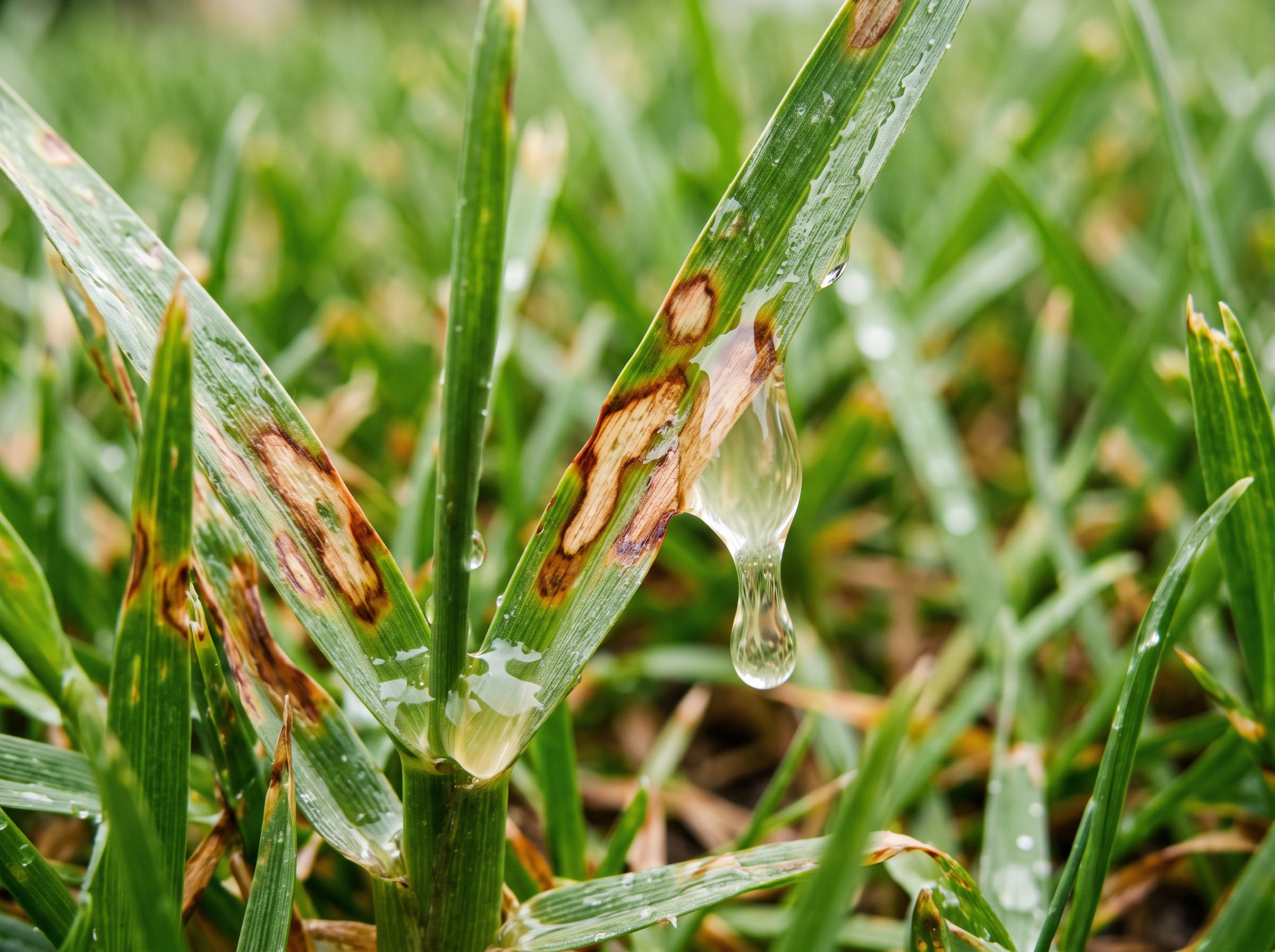
Lawn fungal diseases share the same trigger conditions — warm temperatures, prolonged leaf wetness, and poor air circulation — but they produce distinct visual symptoms. Before buying a fungicide, identify the disease: the wrong active ingredient for the wrong pathogen delivers zero control.
Common diseases by symptom:
| Symptom | Likely disease | Season |
|---|---|---|
| Circular tan or brown patches 6"–3 ft, dark "smoke ring" border | Brown patch (*Rhizoctonia solani*) | Summer (75°F+ nights) |
| Small bleached spots on individual blades, cottony white growth | Dollar spot (*Sclerotinia homoeocarpa*) | Late spring / early summer |
| Faded reddish threads extending from blade tips | Red thread (*Laetisaria fuciformis*) | Cool, wet weather |
| Greasy-looking collapsed turf, cottony mycelium visible at dawn | Pythium blight | Hot, humid nights above 70°F |
| Circular dead patches 1–3 ft, healthy-looking center | Summer patch (*Magnaporthe poae*) | Midsummer |
If you see distinct circular damage rings and overnight humidity has been high, a fungal disease is a near-certain diagnosis. If the damaged area is irregular, dries up with watering, or is surrounded by grub evidence (C-shaped larvae in cut-and-count test), address those causes first — fungicide will not reverse drought stress or grub-root damage.
The 5 Best Lawn Fungicides
1. Scotts DiseaseEx Lawn Fungicide — Best All-Round
Active ingredient: Azoxystrobin (FRAC Group 11) Application type: Granular Coverage: Up to 5,000 sq ft per 10 lb bag Residual: Up to 4 weeks
Azoxystrobin is the most widely used systemic fungicide active ingredient in professional turfgrass management, and DiseaseEx is the most accessible consumer formulation of it. It moves through the plant systemically, protecting new growth and providing both preventive and curative activity against a broad spectrum of pathogens. The label covers 26 diseases — every major disease on this page plus a number of less common ones.
The granular format is the main practical advantage for most homeowners: it goes down with a standard broadcast spreader, requires no mixing, and activates with a quarter inch of irrigation. No sprayer to clean, no concentrate to measure.
Best for: Homeowners who want one product that works preventively before disease arrives and curatively once light symptoms appear. The 26-disease label and systemic activity make it the default choice for most summer fungal pressure.
Limitation: Azoxystrobin belongs to FRAC Group 11. Repeated use of the same FRAC group increases resistance risk. Rotate with propiconazole (Group 3) or thiophanate-methyl (Group 1) every other application cycle.
Buy Scotts DiseaseEx on Amazon →
2. BioAdvanced Fungus Control for Lawns — Best Curative
Active ingredient: Propiconazole (FRAC Group 3) Application type: Granular Coverage: Up to 5,000 sq ft per 10 lb bag Residual: 14 days
Propiconazole is a triazole-class systemic fungicide with stronger curative activity than azoxystrobin — it is the active ingredient most often recommended by university extension programs when disease symptoms are already visible. If brown patch or dollar spot is actively spreading across your lawn right now, BioAdvanced Fungus Control is the pick.
The 14-day re-application interval is shorter than DiseaseEx's 28-day stretch at low disease pressure, but it is appropriate for active outbreak conditions where the pathogen load is higher.
Best for: Lawns that already have visible brown patch, dollar spot, or red thread. Apply at first sign of symptoms and repeat every 14 days until spread stops, then rotate to an azoxystrobin product for continued preventive coverage.
Rotation note: Propiconazole (Group 3) is the natural rotation partner for azoxystrobin (Group 11). Alternate these two products each application cycle to slow resistance development.
Buy BioAdvanced Fungus Control on Amazon →
3. Spectracide Immunox Multi-Purpose Fungicide — Budget Pick
Active ingredient: Myclobutanil (FRAC Group 3) Application type: Ready-to-spray liquid Coverage: Up to 1,200 sq ft per 32 oz bottle Residual: 14 days
Spectracide Immunox has the widest labeled disease list of any product in this group — over 30 lawn and garden diseases — at the lowest unit cost. The ready-to-spray format (attaches to a standard garden hose) makes it accessible without a pump sprayer, and the cost per square foot for smaller lawns or spot treatments is the best in this roundup.
Myclobutanil is a triazole like propiconazole, so it belongs to FRAC Group 3 and should be rotated with Group 11 products (azoxystrobin) to avoid resistance buildup.
Best for: Small lawns, spot treatment, or homeowners who want to minimize upfront cost. The ready-to-spray format is convenient but limits large-area application — for lawns over 2,500 sq ft, the granular options above will be more economical per square foot.
Buy Spectracide Immunox on Amazon →
4. Syngenta Heritage G Fungicide — Longest Residual
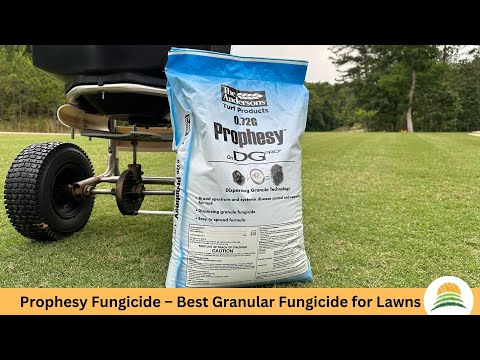
Active ingredient: Azoxystrobin (FRAC Group 11) Application type: Granular Coverage: Up to 10,000 sq ft per bag (varies by bag size) Residual: Up to 28 days
Heritage G is the professional-concentration granular azoxystrobin product — the same active ingredient as Scotts DiseaseEx but at a higher label rate, with a longer labeled residual of 28 days per application. It is consumer-accessible through Amazon and landscaping supply retailers, though the per-bag cost is higher than DiseaseEx.
The 28-day residual makes Heritage G the most cost-effective choice for homeowners running a season-long preventive program on lawns over 3,000 sq ft — fewer applications means lower total-season cost and labor despite the higher upfront price.
Best for: Season-long prevention programs, large lawns, and homeowners who want to maximize interval between applications. Not the best pick for a one-time curative treatment.
Buy Syngenta Heritage G on Amazon →
5. Bonide Infuse Systemic Disease Control — Best Concentrate
Active ingredient: Thiophanate-methyl (FRAC Group 1) Application type: Liquid concentrate (mix with water) Coverage: Up to 16,000 sq ft per quart, diluted Residual: 14–28 days depending on application rate
Thiophanate-methyl is a benzimidazole-class systemic with particularly strong activity against summer patch (Magnaporthe poae) and fusarium diseases that respond less reliably to azoxystrobin and propiconazole. Bonide Infuse is the most widely available consumer thiophanate-methyl product for turf use.
As a concentrate, Infuse delivers the lowest cost-per-square-foot of any product in this group for large lawns — a single quart treats up to 16,000 square feet when applied with a hose-end sprayer. The trade-off is the mixing step and the need for a calibrated hose-end or pump sprayer.
Best for: Lawns with summer patch, fusarium blight, or large-area treatment where cost per square foot matters most. Thiophanate-methyl is in FRAC Group 1 — use it as the third rotation partner alongside azoxystrobin (Group 11) and propiconazole/myclobutanil (Group 3) for a full three-way resistance management rotation.
Disease-Coverage Quick Reference
| Product | Brown Patch | Dollar Spot | Red Thread | Pythium Blight | Summer Patch |
|---|---|---|---|---|---|
| Scotts DiseaseEx (azoxystrobin) | ✓ | ✓ | ✓ | ✓ | ✓ |
| BioAdvanced Fungus Control (propiconazole) | ✓ | ✓ | ✓ | — | ✓ |
| Spectracide Immunox (myclobutanil) | ✓ | ✓ | ✓ | — | — |
| Syngenta Heritage G (azoxystrobin) | ✓ | ✓ | ✓ | ✓ | ✓ |
| Bonide Infuse (thiophanate-methyl) | ✓ | ✓ | — | — | ✓ |
Disease coverage derived from product labels. "✓" = labeled for this disease. "—" = not on the label. Always read the current label before use — formulations can change.
Pythium blight note: for heavy pythium pressure, azoxystrobin products (DiseaseEx, Heritage G) are the most reliable option in this group. Propiconazole and myclobutanil have limited pythium activity. For severe pythium, a dedicated mefenoxam product is the professional standard, but is not included in this consumer roundup.
Application Timing
Getting the product right is only half the equation. Applying too late — after disease has already colonized the root zone — limits even the best curative fungicide.
The best time to apply fungicide is before or immediately at the first symptom, when conditions favor disease development. The most reliable trigger for warm-season fungal diseases is the 150 Rule: when your daily high temperature plus your overnight low reaches 150°F, conditions are active for brown patch and dollar spot. In most of the US, that window runs from late May through August.
For the full timing guide — application windows by region, how to read the 7-day forecast for disease risk, and the rotation schedule that prevents resistance — see our hub article: When to Apply Fungicide to Your Lawn.
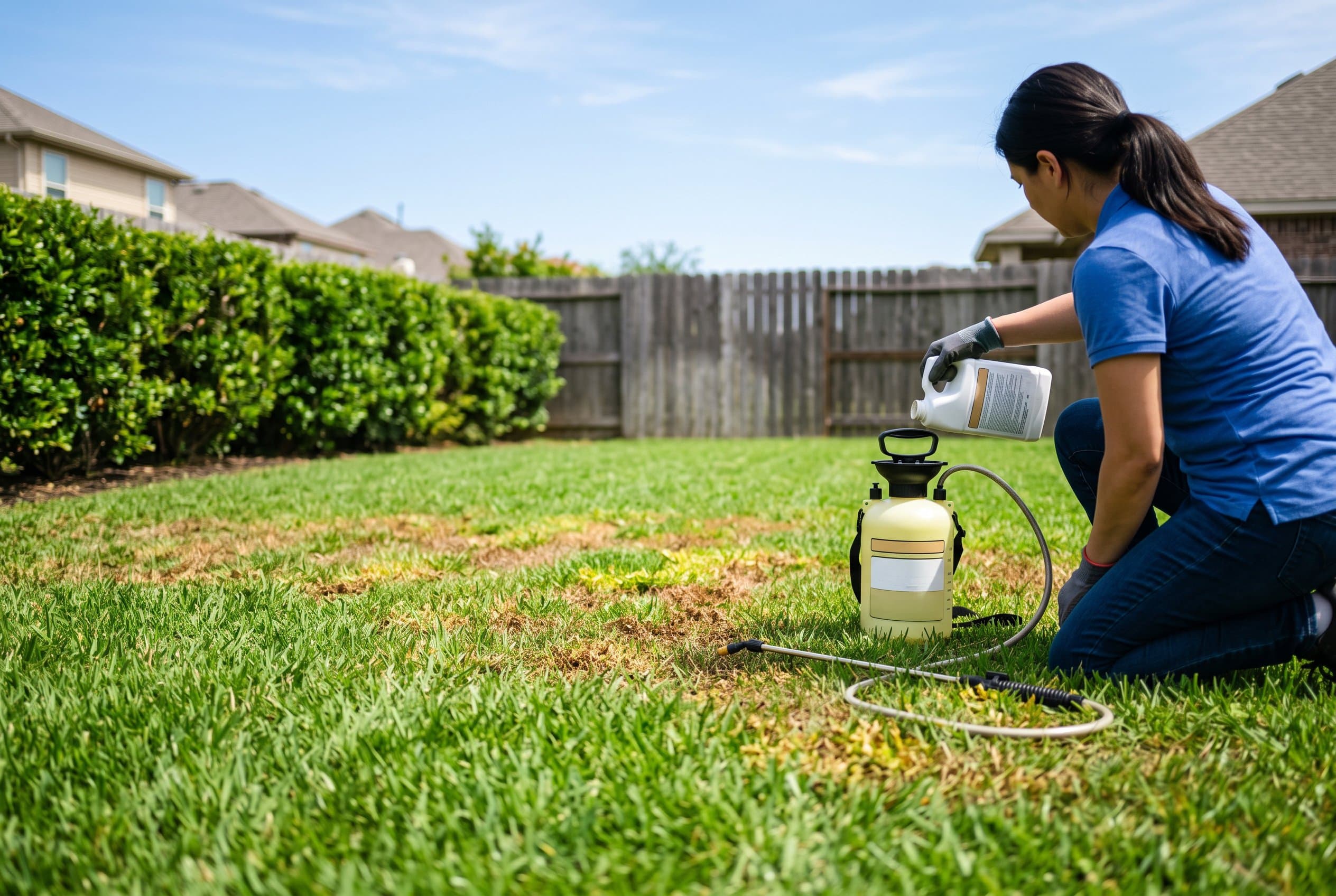
Watering in: Granular products require irrigation to activate. Apply ¼ inch of water within 24 hours of granule application. Do not apply immediately before heavy rain (more than 1 inch) — product can wash off before activating.
Mowing timing: For liquid products, mow before application when possible and wait 24 hours after application before the next mow. For granulars, mow before applying so the granules settle into the canopy rather than sitting on leaf blades.
Frequently Asked Questions
What is the best lawn fungicide for brown patch?
Scotts DiseaseEx (azoxystrobin) and BioAdvanced Fungus Control (propiconazole) are the two strongest choices for brown patch. DiseaseEx works best as a preventive applied before disease pressure hits. BioAdvanced is the better pick when brown patch is already visible — propiconazole has stronger curative activity. Apply either at first sign of the ring-shaped patches and repeat every 14–21 days during hot, humid weather.
Should I use a systemic or contact fungicide on my lawn?
Systemic fungicides (azoxystrobin, propiconazole, thiophanate-methyl, myclobutanil) move into the grass plant and protect new growth — they are generally more effective and longer-lasting than contact products. All five products in this guide have systemic activity. For home lawns, systemic is almost always the better choice.
How often should I apply lawn fungicide?
Preventive programs typically run every 14–28 days depending on the product. Azoxystrobin products (DiseaseEx, Heritage G) can stretch to 28 days under moderate pressure. Propiconazole (BioAdvanced) is re-applied every 14 days. During a disease outbreak, apply curatively at first sign and repeat every 14 days until symptoms stop spreading.
Can I apply fungicide and fertilizer at the same time?
Yes — granular fungicides and granular fertilizers can be applied in the same day, and most homeowners apply them in the same spreader pass. Both require watering in. The exception: if your fertilizer contains a pre-emergent herbicide, check both labels for compatibility notes before mixing in the same hopper.
What is fungicide resistance and how do I prevent it?
Fungal pathogens can develop resistance to a specific active-ingredient class when the same chemistry is applied repeatedly. To slow resistance: rotate between FRAC groups each application cycle — for example, alternate azoxystrobin (Group 11) with propiconazole (Group 3) or thiophanate-methyl (Group 1). All five products in this guide belong to different FRAC groups, making a three-way rotation straightforward.
Footnotes
[^1]: NC State University TurfFiles — Turfgrass Disease Management: https://www.turffiles.ncsu.edu/diseases/ [^2]: Penn State Extension — Lawn Disease Management: https://extension.psu.edu/lawn-disease-management