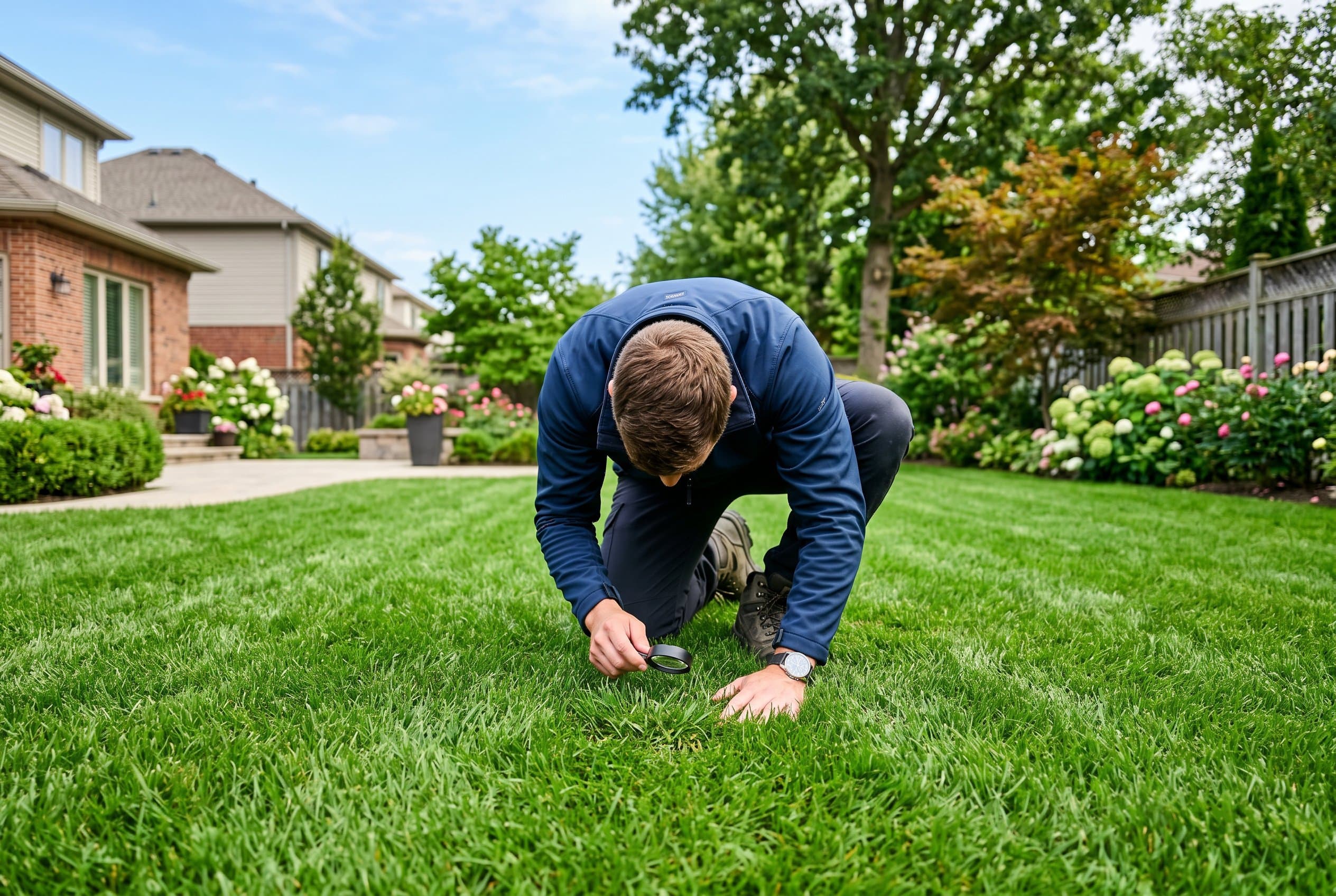
TL;DR. If you flip a patch of dead-looking turf and find fat, white, C-shaped larvae chewing the roots, you have grubs. If the grass tops are chewed short, there are fine silk threads at the soil line at dawn, and small tan moths flush out when you walk the lawn at dusk, you have sod webworms. The two pests cause similar-looking brown patches, but the diagnosis — and the treatment — are completely different.
This page is the disambiguation step. Use the matrix below to figure out which pest you actually have, then jump to the right treatment guide.
Quick ID at a glance
| Clue | Grubs | Sod Webworms |
|---|---|---|
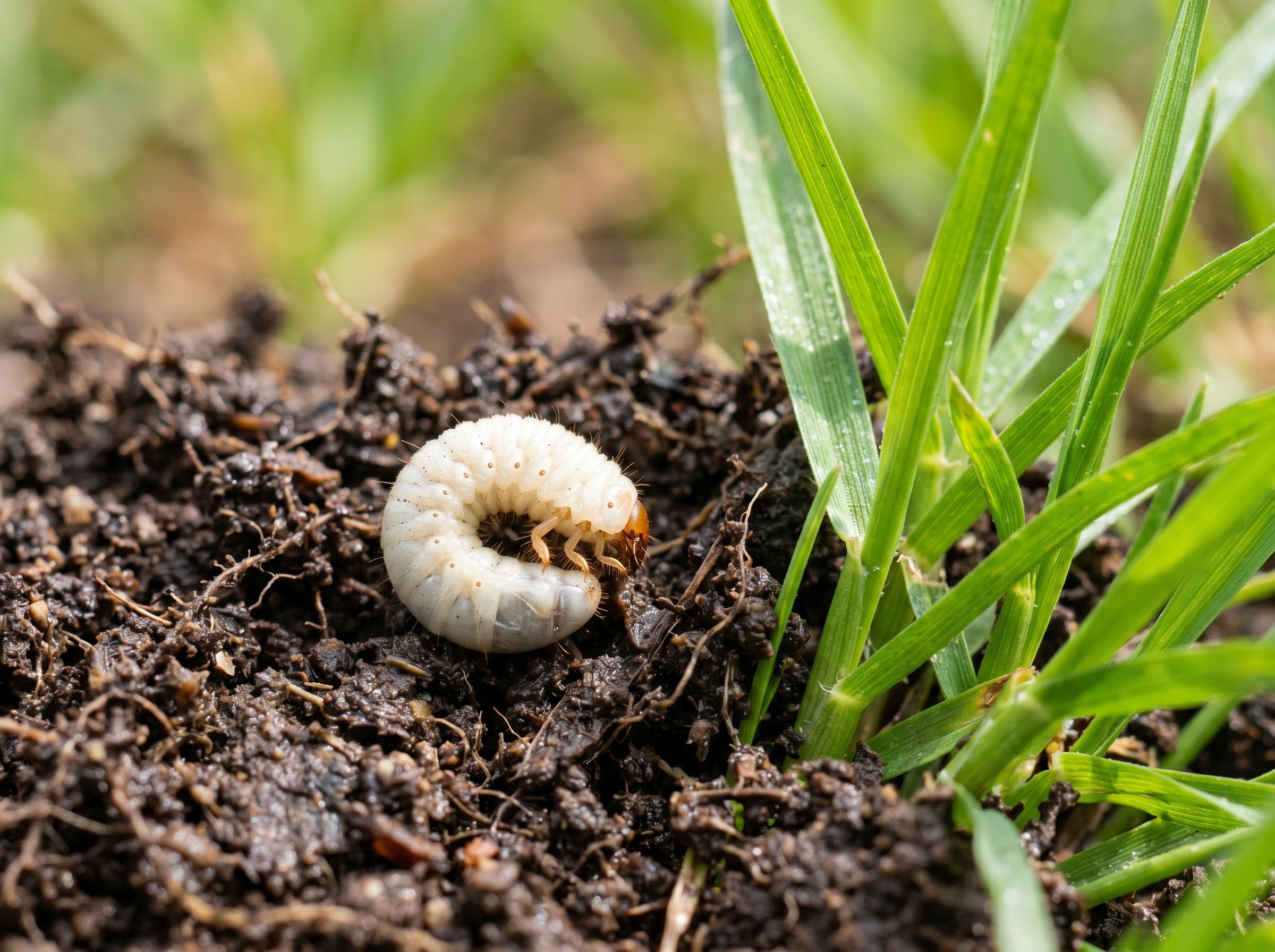
| **What the pest looks like** | Fat, white, **C-shaped** larvae, 1/4"–1" long, brown head, six visible legs at the front | Slender, gray-tan to greenish **caterpillars**, 3/4"–1" long, dark spots along the body, prominent jaws |
| **Where it lives** | **Below the soil**, in the root zone (1–3" down) | **At the thatch line**, in silk-lined tunnels just under the grass blades |
| **Damage to the turf** | **Roots eaten**. Turf lifts away like a loose rug. Spongy underfoot. | **Blades chewed**. Grass looks scalped or notched. Roots still anchor. |
| **Patch shape** | Irregular, **expanding** dead patches, often several feet across by late summer | Small, **scattered** dead spots (a hand to a dinner plate), often coalescing |
| **Smoking-gun sign** | Skunks, raccoons, or birds tearing up the lawn at night to feed | **Silk webbing** visible in dew at dawn; small **tan moths** flushing in zig-zag flight at dusk |
| **Peak damage window** | **Late summer to early fall** (August–October in most of the US) | **May through September**, often with **2–3 overlapping generations** per season |
| **Best treatment timing** | Apply a curative or preventative when grubs are small and feeding near the surface | Treat at the first generation; reapply if a later generation flares |
Three diagnostic checks that cost nothing
1. The tug test
Walk to the edge of a brown patch and pull up on the dead-looking grass with your fingers. If it lifts away in a mat with no roots holding it down, the roots have been eaten — that points to grubs. If the blades are short or chewed but the turf is still anchored, the damage is happening above the soil — that points to sod webworms (or another surface pest).
2. The dawn check
Go outside right after sunrise, before the dew burns off. Look closely at the dead-zone edges. Sod webworms build small silk tunnels at the thatch line, and on a dewy morning those threads catch the light and look like fine spider webbing draped over the grass. Grubs leave no surface trail — their damage is invisible from above.
3. The dusk walk
Stroll across the lawn around sunset. Sod webworm moths are small (about 3/4" long), tan or buff-colored, and they rest in the grass during the day. Walking the lawn flushes them in short, zig-zaggy bursts — they fly a few feet, drop back into the turf, and disappear. A handful of moths per square yard is normal background; clouds of them mean a heavy population is laying eggs.
If none of those checks resolve it, dig. Cut a square of sod 6" × 6" × 2" deep at the edge of a damaged patch and roll it back. More than 5–10 grubs per square foot is a treatment threshold. Webworm larvae will be at the thatch line, not in the soil.
Damage patterns that fool people
The reason these two get confused isn't that they look alike — it's that the brown patch they leave behind looks alike from a distance. A few things to keep in mind:
- Drought stress and dog spots can mimic both. Water the area deeply for a few days; if it greens back up, it wasn't a pest.
- Chinch bugs also produce small, expanding brown patches in sunny, dry parts of the lawn — they're a third disambiguation candidate. If you don't find grubs in the soil or webbing at dawn, rule out chinch bug damage next.
- Dollar spot and brown patch (the fungal diseases) show up in humid weather with very distinctive ring patterns. Pest damage doesn't ring like that.
Peak windows: why timing matters more than the pest
Grubs and sod webworms are on different calendars, and that calendar is your best diagnostic tool if you caught the damage in real time:
- Spring (April–May). Overwintered grubs come back up to feed briefly before pupating. Damage from this round is usually mild. First sod webworm generation starts hatching in May in most of the US.
- Mid-summer (June–July). Sod webworm damage peaks during the second generation. Grub adults (beetles) are flying and laying eggs in the lawn, but grub feeding hasn't started yet.
- Late summer to early fall (August–October). Grub feeding peaks as the new generation grows. This is the window most homeowners discover grub damage. Sod webworm damage is still possible from a third generation but usually winds down.
If your brown patches appeared and expanded suddenly in late August, grubs are the leading suspect. If they've been coming and going since May, webworms are more likely.
What to do next
Use the diagnosis to pick the right next step:
- If it's grubs: quantify the population with the cut-and-count test in our best grub killer for lawns guide (8+ per square foot is the standard action threshold), then plan timing using our hub on when to apply grub killer. If you want to skip the synthetic insecticide, our beneficial nematodes for lawn grubs walkthrough covers a one-season biological that works on every common US grub species, and milky spore vs chemical grub killer compares the slower multi-year Japanese-beetle-only option.
- If it's sod webworms: treat at the first sign of webbing in the dawn check. A single application of a labeled lawn insecticide at the thatch line, watered in lightly, knocks down most generations.
- If it's neither — patches but no pest evidence: the damage is likely environmental. Start with fixing dead patches in grass and rule out drought, scalping, urine spots, or fungal disease before reaching for an insecticide.
- If you're still not sure: bring a sample to your county extension office. They'll ID it for free, usually same-day.
Once the pest is dead — whichever one it was — the bare and thinned spots won't recover on their own. See how to fix bare spots in lawn for the soil prep, seed, and watering plan that brings the dead zones back.
The pest you treat for matters. Spraying a webworm product won't reach grubs in the soil, and a soil-applied grub product won't help when the chewing is happening at the thatch line. The good news: ten minutes with a trowel, a flashlight, and the matrix above is almost always enough to tell them apart.
FAQ
Can you have grubs and sod webworms in the same lawn at the same time?
Yes. They're independent pests on different parts of the plant, and a stressed lawn is hospitable to both. If your dig test turns up grubs and your dawn check turns up webbing, treat for both — but stage the applications a week or two apart so you can tell what worked.
What time of year is grub damage most visible?
Late summer through early fall, typically August through October in most of the continental US. That's when this year's grub generation reaches its largest, hungriest size, and the cumulative root damage shows up as turf you can roll back like carpet.
Do sod webworms come out during the day?
The adult moths rest in the lawn during the day and fly at dusk; the larvae stay hidden in their silk tunnels day and night, feeding mostly after dark. The easiest time to spot webworm activity is at dawn (the webbing) or dusk (the moths) — midday inspection rarely shows much.
How many grubs per square foot is a real problem?
A healthy, well-watered lawn can tolerate 5 or fewer grubs per square foot without visible damage. Above 10 per square foot is a clear treatment threshold. Between 5 and 10, the right move depends on how stressed the lawn already is.
Does grub treatment also kill sod webworms?
Sometimes, by accident, if the product is broad-spectrum and gets applied at the surface — but most modern grub products are formulated to move down into the root zone and won't reach larvae living at the thatch line. Don't assume one product covers both; match the treatment to the pest you actually have.
If I see a few moths in the lawn at dusk, do I have a webworm problem?
Not necessarily. A few moths per square yard is background noise. The threshold is closer to a small cloud flushing as you walk — 10–15 moths per square yard, sustained over several evenings — combined with visible damage. Moths alone aren't enough to justify spraying.