

Quick Answer: Poa annua (annual bluegrass) is a winter annual that germinates when fall soil temperatures fall below about 70°F, so a pre-emergent herbicide must be down before that threshold. Apply prodiamine, dithiopyr, or indaziflam in mid-to-late August in northern lawns, September in the transition zone, and late September through October in the Deep South. Skip pre-emergent any year you plan to overseed.
Key Takeaways
- Poa annua germinates in late summer/fall as soil temperatures drop below ~70°F — fall is THE control window[1]
- Prodiamine, pendimethalin, and dithiopyr are proven dinitroaniline pre-emergents; indaziflam (Specticle) adds a different mode of action for warm-season turf[1][2]
- Timing shifts by region: apply earlier as you move north, later as you move south
- Pre-emergent blocks grass seed too — you cannot overseed and apply pre-emergent in the same fall[1]
- Spring applications largely fail because poa annua has already germinated and set seed
- Rotate chemistries yearly to slow herbicide resistance[3][4]
Why Poa Annua Is a Fall Problem, Not a Spring One
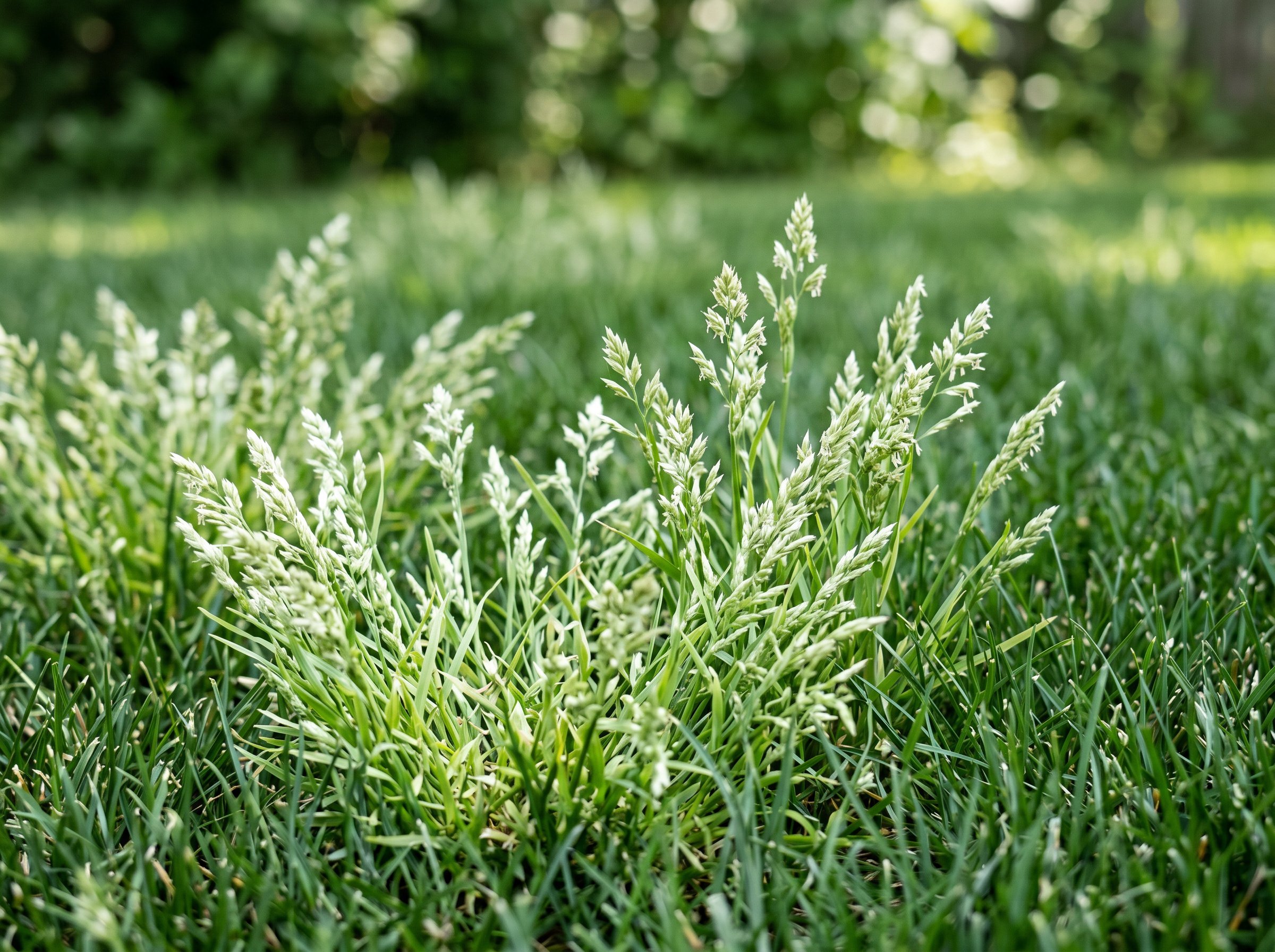
Annual bluegrass is a cool-season winter annual. Unlike crabgrass, which sprouts in spring, poa annua seed germinates in late summer and early fall as soil temperatures fall below roughly 70°F, usually after rain or irrigation restores soil moisture[1]. The seedlings grow through fall, survive winter as small clumps, then explode with bright green, fine-textured foliage and greenish-white seed heads in spring. Each plant can produce hundreds of viable seeds that stay dormant in the soil for years.
This life cycle is exactly why a fall pre-emergent is the single most effective tool against poa annua. A pre-emergent forms a chemical barrier in the top layer of soil that stops seeds as they try to germinate. Get that barrier in place before soil temperatures drop through the 70°F trigger, and you intercept the entire fall flush. Miss the window, and the seedlings are already up — and a pre-emergent does nothing to plants that have already emerged.
Soil Temperature and Timing by Region
Because germination is driven by soil temperature rather than the calendar, timing shifts with latitude. Cooler northern soils cross the 70°F threshold weeks earlier than warm southern soils, so northern lawns need pre-emergent down sooner. A good rule is to have the product applied and watered in two to three weeks before soil temperatures are expected to reach 70°F.
| Region | Soil-temp situation | Typical application window |
|---|---|---|
| North / Upper Midwest & Northeast (cool-season lawns) | Soil cools below 70°F earliest | Mid-to-late August |
| Transition zone (TN, KY, VA, NC, MO) | Soil crosses 70°F in early-to-mid fall | Late August through late September[[3]](#user-content-fn-3) |
| Deep South / Gulf Coast (warm-season lawns) | Soil stays above 70°F the longest | Late September through October[[2]](#user-content-fn-2) |
A common field cue for southern lawns is to apply when daytime highs settle to around 75°F for several consecutive days[3]. For warm-season turf specifically, university guidance places indaziflam (Specticle) applications around September in the upper South and October in the Deep South[2]. Because poa annua germinates over an extended period, many programs use a split approach: a first application at the soil-temp trigger, then a second roughly 6 to 10 weeks later to catch later-germinating plants[3].
Whatever your region, use a soil thermometer or a local soil-temperature tracker rather than a fixed date. Weather swings a year's timing by a week or two, and being a week early is far better than a week late. For a broader seasonal plan, see our fall weed control strategy.
Choosing a Pre-Emergent: Active Ingredients That Work
Most effective poa annua pre-emergents fall into two chemistry groups:
- Dinitroanilines (DNA): prodiamine (Barricade), pendimethalin (Pendulum, Halts), and the related dithiopyr (Dimension). These are the workhorses for home lawns — widely available, research-backed, and good-to-excellent on annual bluegrass when applied on time[1]. Prodiamine is prized for its long residual; dithiopyr adds a short window of early post-emergent activity on very young seedlings.
- Indaziflam (Specticle): a cellulose-biosynthesis inhibitor with a different mode of action, giving strong pre- and early post-emergent control on established warm-season turf[2]. It carries some turf-injury risk on sandy, low-organic-matter soils and on stressed lawns, so follow label rates carefully.
For cool-season lawns, some homeowners also lean on ethofumesate (Prograss), which requires two or three applications spaced three to four weeks apart[4]. Warm-season lawns have additional options such as atrazine and simazine, which offer excellent control with a 4-to-6-week residual but are restricted to certain grass types[4].
Two rules apply to every product: water it in with about 0.25–0.5 inch of irrigation within 24 hours if rain isn't expected, because the barrier won't form without moisture; and rotate modes of action from year to year. Repeated use of the same chemistry has already produced herbicide-resistant poa annua populations, including documented triazine resistance, so alternating groups is essential insurance[3][4]. For a wider look at your options, review our guide to weed control methods.
The Overseeding Conflict You Can't Ignore
Here is the trap that catches most homeowners: fall is also the best time to overseed a cool-season lawn — and pre-emergent herbicides block all seed germination, not just weeds. If you apply prodiamine in late August and then try to overseed in September, your grass seed will fail right alongside the poa annua[1]. Most pre-emergents prevent successful seeding for two to four months after application[4].
You have to choose. The two workable paths are:
- Skip pre-emergent in overseed years. Accept some poa annua pressure this season, get your new grass established, and resume pre-emergent the following August. If you're planning a fall seeding, our fall grass seed timing guide walks through the overseeding window.
- Use mesotrione (Tenacity) at seeding. Mesotrione suppresses poa annua while remaining safe for germinating cool-season seedlings, letting you seed and fight annual bluegrass at the same time — the one common way to have both.
Post-Emergent Fallbacks and Why Spring Is Too Late
If you miss the pre-emergent window and poa annua is already up, post-emergent control becomes your only option, and it's harder. Warm-season lawns can use selective post-emergents such as foramsulfuron (Revolver) or trifloxysulfuron (Monument); cool-season lawns have far fewer choices, mainly repeated ethofumesate applications[4]. None are as clean or cheap as simply preventing germination in the first place.
This is also why spring pre-emergent applications largely fail for poa annua. By spring, plants have already germinated, matured, and started setting the next generation of seed — a pre-emergent barrier has nothing left to stop. Spring pre-emergents are for crabgrass, a summer annual with the opposite calendar; see when to apply weed killer in spring for that timing. If you're battling other warm-season weeds later in the year, our summer weed control guide covers that window too.
Conclusion
Poa annua rewards precision. Because it germinates on a soil-temperature trigger rather than a date, the whole game is getting a pre-emergent barrier down before soil temps fall below 70°F — mid-August in the north, September across the transition zone, and October in the Deep South. Choose a proven chemistry like prodiamine, dithiopyr, or indaziflam, water it in, and rotate products year to year to stay ahead of resistance. Just remember the overseeding conflict: any fall you plan to seed, skip the pre-emergent or reach for mesotrione. Nail the timing this fall and you'll head off next spring's bright green invasion before it ever sprouts.