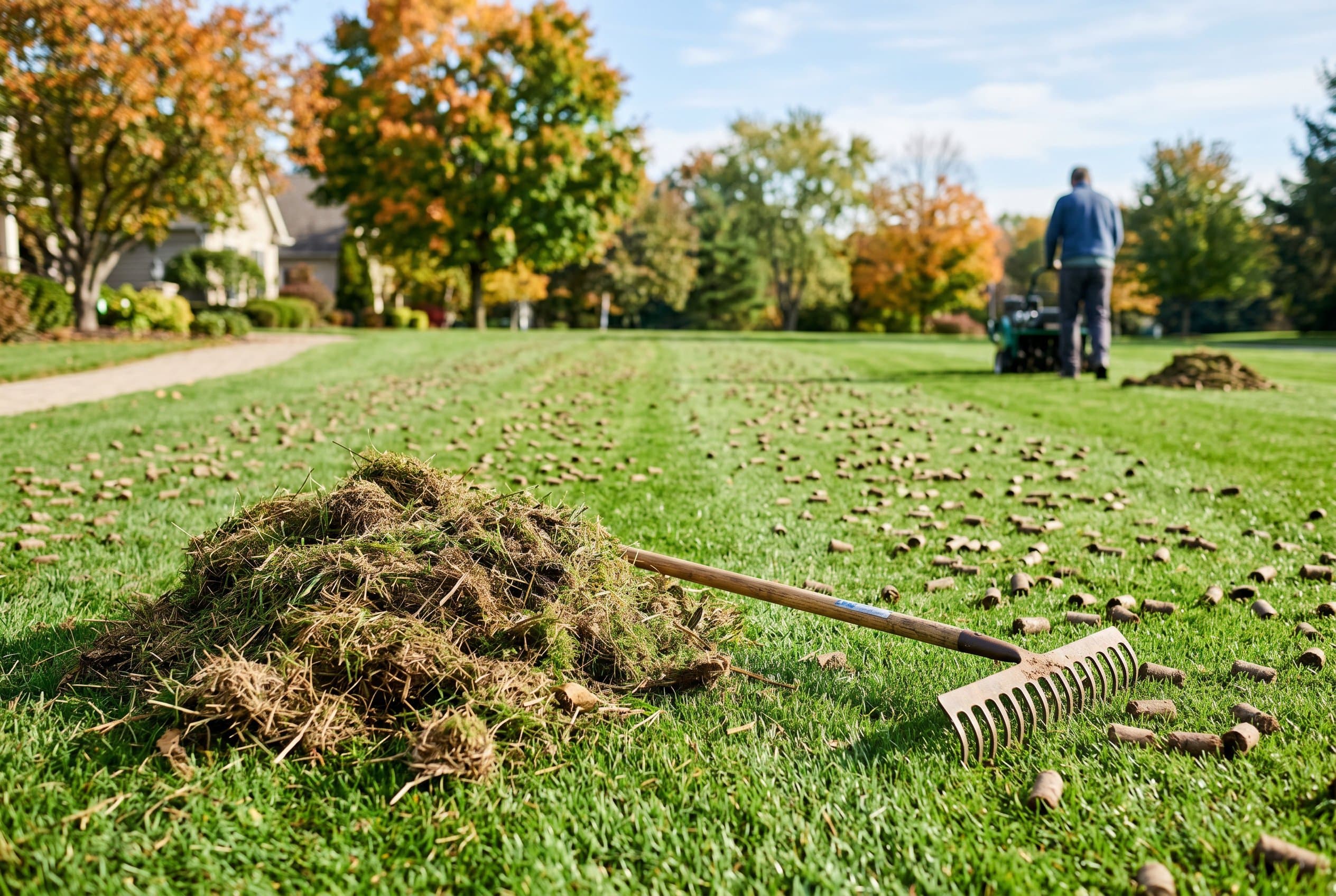
Quick Answer: Dethatching and aeration fix two different problems. Dethatching removes the layer of dead stems and roots (thatch) sitting above the soil — do it when thatch exceeds 1/2 inch. Core aeration pulls plugs of soil to relieve compaction below the surface — do it when soil is hard and water pools or runs off. Most lawns benefit from regular aeration, but only thatch-prone grasses like Kentucky bluegrass, bermuda, and zoysia routinely need dethatching.
Key Takeaways
- Thatch under 1/2 inch is healthy; over 1/2 inch blocks water, air, and fertilizer — that's when dethatching pays off
- Dethatching uses a vertical mower or power rake to tear out debris; aeration uses hollow tines to extract soil cores
- The screwdriver test diagnoses compaction: if a screwdriver won't slide into moist soil, aerate
- Kentucky bluegrass, bermuda, and zoysia build thatch; tall fescue and perennial ryegrass rarely need dethatching
- Timing is identical for both jobs: early fall for cool-season lawns, late spring to early summer for warm-season lawns
Introduction
Dethatching and aeration get lumped together because both are "lawn renovation" chores done with rented machines in the same season. But they treat opposite problems — one clears an obstruction above the soil line, the other opens up the soil itself. Doing the wrong one wastes a weekend and can genuinely damage your lawn. Here's how to tell which your lawn actually needs, backed by university turfgrass research.
What's the Difference Between Dethatching and Aeration?
Dethatching solves a problem above the soil line; aeration solves a problem below it.
What dethatching does
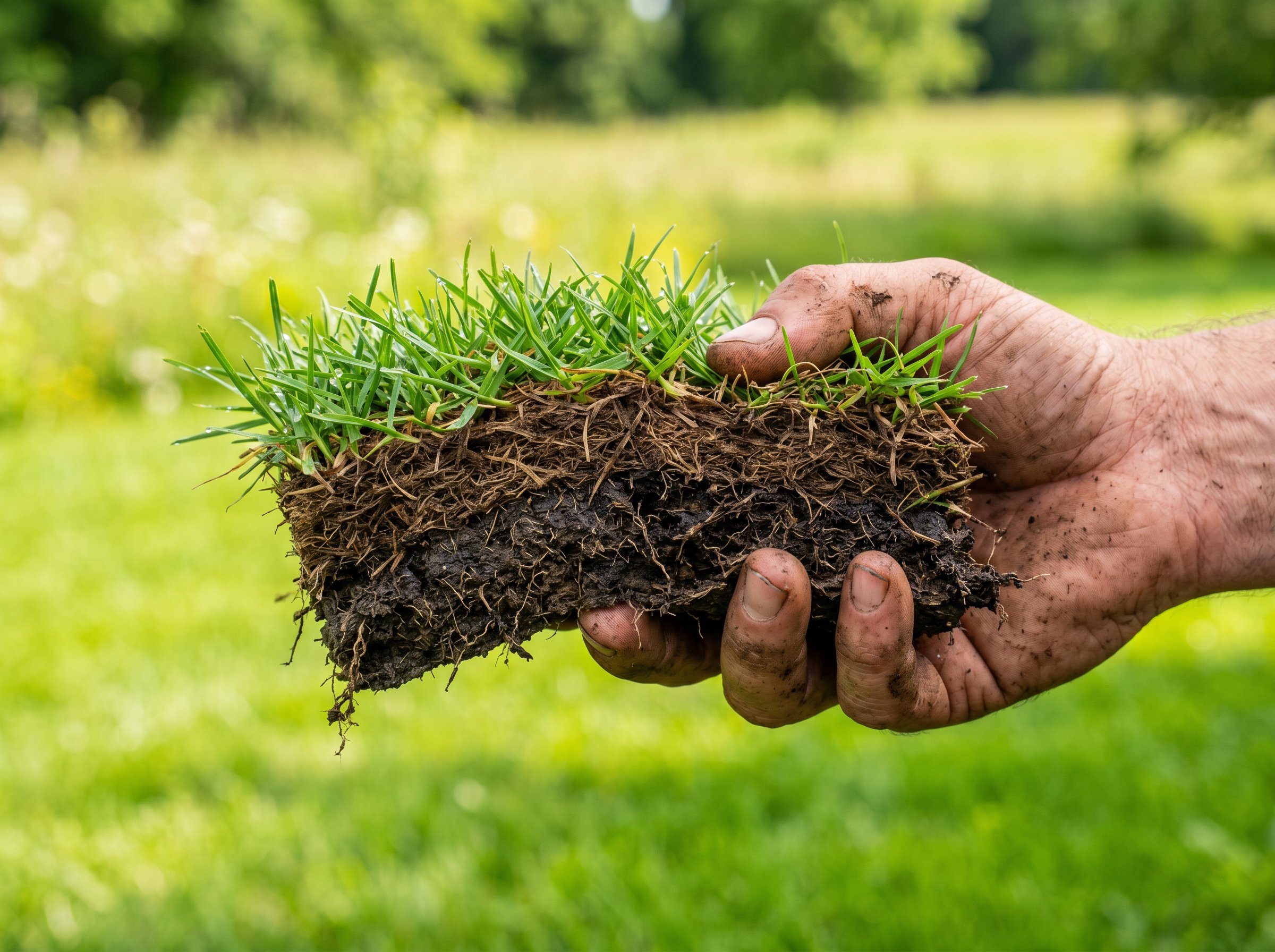
Thatch is a tightly interwoven layer of living and dead stems, crowns, and roots that builds up between the green blades and the soil surface[1]. A thin layer is normal — even beneficial, cushioning the crowns and insulating soil. But past about 1/2 inch, thatch acts like a thatched roof: it sheds water, blocks air and fertilizer, and grass roots start growing in the thatch instead of the soil, leaving the lawn shallow-rooted and drought-prone[1].
A dethatcher (vertical mower or power rake) spins steel blades or spring tines perpendicular to the ground, slicing through the layer and tearing the debris to the surface, where you rake and haul it away[1]. It is deliberately violent — which is why timing matters so much.
One myth worth killing: grass clippings don't cause thatch. Clippings are mostly water and decompose quickly. Thatch comes from tough, fibrous stem and root tissue that resists decay[1].
What core aeration does
A core aerator drives hollow tines into the ground and extracts plugs of soil, leaving thousands of open holes. That relieves soil compaction, lets water and oxygen reach the root zone, and improves fertilizer uptake[3]. It even helps with thatch: the extracted cores crumble over the lawn and top-dress it with soil microbes that actively decompose the thatch layer[1].
Crucially, coring causes far less stress to the lawn than power raking — which is why the University of Missouri Extension recommends it as the preferred treatment for moderate thatch, since it fixes compaction at the same time[2]. Spike shoes and rolling spikers don't count: they push soil sideways and can worsen compaction. Only hollow-tine core aeration removes material.
Two 60-Second Tests to Diagnose Your Lawn
Don't guess — measure.
The wedge test (for thatch). Cut a pie-shaped wedge about 2 inches deep from the lawn and measure the brown, spongy layer between the green blades and the soil surface[1]. Under 1/2 inch: leave it alone. Over 1/2 inch: plan to dethatch.
The screwdriver test (for compaction). Push a screwdriver into moist soil. If it slides in several inches with light pressure, your soil is fine. If it stalls after an inch or two, the soil is compacted and the lawn needs core aeration.
Decision table: symptom → treatment
| Symptom | What it means | Treatment |
|---|---|---|
| Spongy, bouncy feel underfoot | Thatch layer over 1/2 inch | Dethatch |
| Wedge test shows 1/2+ inch of brown debris | Excess thatch | Dethatch |
| Water beads up or sheds off, dry spots despite watering | Thatch repelling water | Dethatch |
| Screwdriver won't push into moist soil | Compaction | Aerate |
| Water pools or runs off, hard bare patches | Compaction | Aerate |
| Heavy foot traffic, clay soil, thin growth | Compaction | Aerate |
| Spongy AND hard soil underneath | Both problems | Dethatch, then aerate |
| Thatch over 1 inch on a weak lawn | Severe buildup | Aerate repeatedly over 2–3 seasons; removing it all at once can kill the lawn[[2]](#user-content-fn-2) |
Which Grasses Build Thatch — and Which Don't
Thatch is largely a species problem. Aggressive spreaders that grow from stolons and rhizomes produce the tough, decay-resistant tissue that becomes thatch[2]:
- High thatch potential: Kentucky bluegrass, bermudagrass, zoysiagrass, creeping bentgrass
- Low thatch potential: turf-type tall fescue, perennial ryegrass
If you grow tall fescue, you may never need a dethatcher — put your budget toward aeration instead. Overfertilizing with nitrogen, overwatering, and compacted or acidic soil that suppresses microbes all accelerate thatch buildup in any species[2].
When to Dethatch or Aerate (Timing by Grass Type)
Both jobs injure grass on purpose, so the rule is identical: only when the lawn is growing vigorously enough to recover.
- Cool-season lawns (bluegrass, fescue, ryegrass): early fall — late August through early October — is best, with spring (April) a second choice[1]. Iowa State's turf program calls September and April the ideal aeration windows, when cool temperatures and moisture help the lawn heal fast[3]. See our guides on fall aeration timing and the best time to dethatch.
- Warm-season lawns (bermuda, zoysia): late spring into early summer, once the lawn is fully green and actively growing. University of Georgia lawn calendars slot aeration for May through August and dethatching for June–July[4]; Missouri Extension similarly targets mid-June for zoysia and bermuda[2].
Dethatching at the wrong time is the costliest mistake in lawn care. Power raking a half-dormant lawn in early spring, or a heat-stressed one in midsummer, tears out living crowns the grass can't replace — and the bare soil left behind becomes a weed nursery. Soil moisture matters too: work when soil is moist but not wet, since dry soil stops the tines and wet soil smears and clogs them[3]. (More on that in should you dethatch before or after rain.)
Can You Do Both — and in What Order?
Yes, and on a thatchy, compacted lawn you should. Dethatch first so the aerator's tines reach actual soil rather than bouncing on a spongy mat, then aerate, then overseed and fertilize into the open holes — the perfect one-weekend fall renovation. The exception is severe buildup: Minnesota Extension notes you may need to aerify before vertical mowing when thatch is heavy, to soften the layer and kick-start decomposition[1].
Frequency differs, though. Aeration is routine — annually, or twice a year on clay soil and high-traffic lawns[3]. Dethatching is corrective — only when measurement says so, which for many lawns is every few years or never.
What Each Costs
- Core aeration: professional service typically runs $75–$206 for an average lawn (about $140 nationally); renting a core aerator costs roughly $65–$110 per day. Get a number for your exact square footage with our aeration cost calculator.
- Dethatching: a power rake rents in the same $60–$100-per-day range, while hiring it out usually costs somewhat more than aeration ($150–$250 for typical lawns) because of the debris hauling — dethatching a lawn generates a startling volume of material, often dozens of bagfuls[1].
Since rental rates are nearly identical, let the diagnosis — not the price — pick the machine.
Conclusion
Dethatching and aeration aren't competitors; they're different tools for different layers of your lawn. Measure a wedge: more than 1/2 inch of thatch means dethatch. Probe with a screwdriver: if it won't slide into moist soil, aerate. When in doubt, aerate — it's gentler, it relieves compaction, and it slowly digests thatch on its own. Whichever you choose, schedule it for early fall on cool-season grass or late spring on warm-season grass, and give the lawn water and fertilizer afterward so it heals fast.