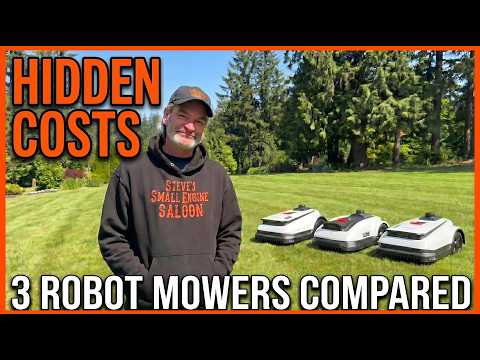
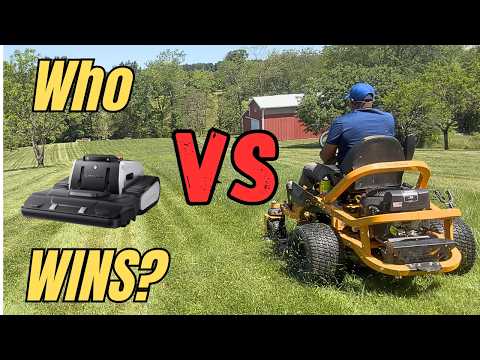
Quick Answer
A traditional mower wins on upfront cost, steep-slope tolerance, bagging, and brute force on tall or wet grass. A robot mower wins on time-back, edge-to-edge consistency, quiet operation, and a healthier cut from frequent micro-trims. The right choice usually comes down to lot size and shape, what your time is worth, and whether your yard has slopes, drop-offs, or heavy obstacles that exclude a robot.

Why this comparison matters
Robot mowers have moved from novelty to a real category — wire-free RTK GPS models now cover up to ~1.7 acres and slopes up to 45°, while sub-quarter-acre electric and gas-powered traditional mowers have gotten cheaper and lighter. That means the "which category" question is no longer obvious. For most homeowners, this is now a real decision tree rather than a default to whatever's at the hardware store.
This guide is category vs. category — not a head-to-head between specific brands. For brand-level shopping criteria, see the linked equipment guides at the end of each section.
Comparison table at a glance
| Attribute | Robot mower | Traditional mower (push / self-propelled / rider) |
|---|---|---|
| Typical upfront cost | $800–$5,000+ | $150–$3,000 (push to rider) |
| Setup time | Several hours (boundary mapping, wire install) to half a day for RTK calibration | Minutes (unbox, fuel/charge, mow) |
| Active human time per mow | ~0 minutes | ~20–60 minutes per quarter-acre |
| Best lot size | 0.05–1.73 acres (model-dependent) | Any — push <0.25 ac, self-prop 0.25–0.75 ac, rider 0.75 ac+ |
| Slope tolerance | 20–30° standard; 35–45° on premium tracked / RTK units | Push 15–20°; self-propelled 20–25°; rider rated case-by-case |
| Noise | ~55–65 dB (conversation-level) | Gas: 90–100 dB; electric: 70–80 dB |
| Cut quality | Frequent micro-cuts, continuous mulching | Single pass per mow; scalp risk on long grass |
| Bagging clippings | No (mulches only) | Yes (most decks) |
| Maintenance burden | Blade swaps 1–3× per season; software updates; perimeter-wire repairs (wired models only) | Blade sharpening 1–2× per season; oil & spark plug (gas); battery care (electric) |
| Expected lifespan | 7–10 years (battery is the limiting part) | 8–10 years electric; 10–15+ years gas with service |
| Theft / weather risk | Real consideration — geofence, lock-down, garage at season end | Stays in shed or garage; no off-season theft risk |
| Best fit | Time-poor homeowners, fenced yards, flat-to-moderate terrain, frequent mowing zones | Budget-first owners, steep yards, large open acreage, bagging-required setups |
Skim the rows that matter most for your lawn; the sections below dig into the categories where the answer isn't obvious.
Capital cost vs total cost of ownership (TCO)
The sticker-price gap is the loudest number in this comparison, but it's also the most misleading.
Robot mower upfront: Entry models cluster around $800–$1,500, mid-tier units run $1,800–$3,000, and premium wire-free RTK GPS units with the largest coverage areas push $3,500–$5,000+. Add a charging dock pad, a Wi-Fi extender if your yard reaches past your router, and (for wired models) a perimeter-wire kit.
Traditional mower upfront: A reliable push mower starts at $150–$300. Self-propelled gas models land at $400–$800, premium electric self-propelled at $500–$1,000, and rear-engine or zero-turn riders run $1,500–$3,500+. Most homeowners already own a string trimmer; both categories need one.
Where TCO actually diverges:
- Fuel and energy. Gas mowers run on a few gallons per season for most lots; electric and robot mowers run on cents-per-mow charging. Over ten years, the energy gap is meaningful but not category-defining.
- Service and parts. Gas mowers need oil changes, spark plugs, air filters, and the occasional carburetor cleaning — $40–$120 a season if you DIY, $100–$200 if you take it in. Robot mowers swap blades more often (small replaceable razor blades, $20–$40 a season) and may eventually need a battery pack ($150–$400) around year 5–7. Wired robots also pay for perimeter-wire repairs after pet damage, aeration accidents, or freeze-thaw breaks.
- Time you're not buying back. This is the line item people forget. For a 0.25-acre lot mowed weekly, you spend roughly 25–30 active hours per season pushing a mower. At any honest hourly value, that adds up — and the robot mower's TCO equation only looks favorable when you actually credit yourself for that time.
The honest summary: robot mowers usually break even with a mid-tier traditional setup somewhere between years 4 and 7, assuming you would otherwise pay a lawn service or you genuinely value the recovered weekend hours. If you already enjoy mowing, do your own service, and run a small deck, traditional stays cheaper on paper for the full ownership window.
Maintenance burden
The maintenance profiles are different in kind, not just in degree.
Traditional mower maintenance is concentrated and seasonal. Sharpen blades once or twice a year, change oil annually on gas units, check the air filter, top off fluids, and winterize at season's end (see our winterizing lawn mower complete guide for the gas-side checklist). Skip these and the engine still runs — until it doesn't.
Robot mower maintenance is distributed and small-ball. Swap the small razor blades every 1–3 months during mowing season, brush grass clippings off the deck and sensors weekly, keep the charging contacts clean, and apply firmware updates when prompted. The blades themselves cost less than a single tank of gas, but the cadence is higher and the consequences of skipping them show up as poor cut quality rather than a dead engine.
Two real-world wrinkles to plan for:
- Wired robots add perimeter-wire troubleshooting to the maintenance load. Wire breaks happen — pets, aerator tines, freeze-thaw — and finding the break is the kind of unbudgeted afternoon that ruins a Saturday. Wire-free RTK GPS robots avoid this entirely, which is part of why we've covered them as a separate category in the wire-free robotic mowers large-lawns guide.
- Batteries are the limiting component on both electric traditional mowers and on robot mowers. Expect a replacement somewhere in years 5–8 on either side. Build that line item into your TCO math, not into your "it died" panic.
Suitable lot sizes and shapes
Lot size and shape matter more than acreage alone.
- Under 0.1 acre, flat, simple shape: Either category works. Push mowers are the lowest-friction default; small-yard robot mowers are an honest upgrade if you value the time-back (see our robot lawn mower small yards guide).
- 0.1–0.5 acre, mixed shape with garden beds and trees: Robot mowers shine if the layout is fenced and a mapped boundary makes sense. Traditional self-propelled mowers stay viable for owners who don't mind the time.
- 0.5–1.5 acres, open or moderately complex: Wire-free RTK GPS robots become competitive with self-propelled and small riders. Below this size most rider mowers are oversized.
- 1.5 acres and up, open layout: Riders and zero-turns dominate. A handful of premium robots reach into this range — see our wire-free robotic mowers large-lawns guide for the category — but the use case is narrower.
- Narrow side yards, gated alleys, multiple disconnected zones: Both categories struggle. Robots need either a dock per zone or the ability to be manually moved between zones; traditional mowers cope better but still cost time.
Edge cases that exclude robots outright: steep septic-mound coverage, lakefront drop-offs without fencing, properties with frequent off-leash visiting dogs, and any zone where theft risk outweighs geofence protection.
Slope and obstacle handling
This is the single biggest exclusion category for robot mowers.
Robot mowers handle sustained slopes of 20–30° on most consumer units, with premium tracked or RTK-GPS models stretching into the 35–45° range under good conditions. The catch is "good conditions" — wet grass, loose soil after aeration, or transitional terrain (slope into flat into slope) all increase slippage and trip the safety cutoff. Obstacles up to ~2 inches tall are typically navigable; sticks, gardening tools left out, and pet toys are not.
Traditional mowers handle slopes differently by sub-category. Push mowers are physically demanding above 15–20°; self-propelled drive helps to about 25°; rear-engine riders and zero-turns each have manufacturer-rated slope limits that should be respected literally, because rollovers are the dominant fatal mowing injury. For obstacles, traditional mowers are tolerant of debris up to deck height but punish a hidden rock or root with a bent blade and an alignment job.
If your yard has any combination of (1) sustained >30° slope, (2) frequent wet-grass operation, or (3) unfenced drop-offs, a traditional mower is the safer default regardless of cost preference.
Perimeter-wire vs wire-free options
Within the robot mower category, the boundary system is the single biggest setup and maintenance variable.
- Wired perimeter robots are the older and cheaper architecture. Installation is a one-time several-hour job — burying or pinning a low-voltage wire around the mow zone and around obstacles. After install, navigation is reliable but the wire becomes a hidden maintenance liability (see the maintenance section above).
- Wire-free RTK GPS and AI-vision robots map the lawn through a base station and onboard sensors. Setup is faster, the boundary is editable from a phone, and there's no buried wire to break. The tradeoff is cost (premium tier only), GPS line-of-sight requirements (tall tree canopy can degrade fix), and a steeper learning curve on the mapping app.
For most homeowners weighing the robot side of this comparison, the wire-free models are now where the category is genuinely improving year over year. Our wire-free robotic mowers large-lawns guide covers what to look for at the category level (RTK accuracy, slope rating, deck width, app maturity).
Expected lifespan
Robot mowers: Plan on 7–10 years of useful life, with the lithium battery pack as the typical limiting component. Mid-tier models commonly need a battery replacement around year 5–7; premium models stretch further. Frame and motor components routinely outlast the battery.
Traditional mowers: Electric push and self-propelled mowers usually run 8–10 years with normal care; gas mowers, kept tuned, often hit 10–15 years and rebuilt engines push further. Riders and zero-turns have the longest mechanical life of the comparison — 15+ years is common with regular service.
The takeaway: traditional mowers have a longer ceiling on raw lifespan, but the useful lifespan gap is smaller than the spec sheets suggest once you factor in battery replacements (both sides) and the way robot-mower software updates extend feature life.
Who should buy which — a decision matrix
| If your priority is… | And your lot is… | Consider |
|---|---|---|
| Lowest upfront cost | Any size | Traditional push or self-propelled mower |
| Maximum time-back | <1.5 acres, mostly flat, fenced or low theft risk | Robot mower (wire-free if budget allows) |
| Steep-slope coverage (>30°) | Any | Self-propelled walk-behind or rated rider — not a robot |
| Bagging for fall leaves / clipping removal | Any | Traditional mower with bagging deck |
| Quiet operation (early morning, close neighbors) | <1 acre | Robot mower or electric push mower |
| Large open acreage (>1.5 acres) | Flat or rolling | Rider or zero-turn (or premium wire-free robot in narrow cases) |
| Smallest weekly hands-on effort | <0.5 acre | Robot mower |
| Toughest tall-grass / once-a-month cuts | Any | Traditional mower — robots struggle on long grass |
| Lowest total carbon footprint | <0.5 acre | Electric push or robot mower |
If two priorities pull in different directions — for example, "lowest upfront cost" and "maximum time-back" — the honest answer is that the categories really do trade off, and one of those priorities has to give. Decide which one matters more, then revisit the table.
Companion reads
Once you've narrowed to a category, these guides cover the next layer of detail:
- General mowing best-practices regardless of mower type: lawn mowing tips and how often should I mow my lawn.
- Robot-mower category specifics: robot lawn mower small yards guide, wire-free robotic mowers large-lawns guide, and an example single-product review at Eufy E18 robot mower review.
- Traditional-mower seasonal care: winterizing lawn mower complete guide.
For the rest of our equipment coverage, browse the equipment topic hub.
The honest bottom line
There is no single "best" mower category — there's a best fit for your yard, your slopes, your obstacle profile, and your time. Robot mowers have closed enough of the price and capability gap that they're a real option for most sub-1.5-acre lots; traditional mowers still own the cheap-and-simple and steep-and-rough ends of the spectrum. Use the comparison table to find your row, then use the decision matrix to pick a category. The mower-shopping decision starts there, not at the brand level.