Quick Answer
Winterizing a lawn mower takes about 45 minutes and involves 7 steps: drain or stabilize fuel, change oil, clean the deck, sharpen or replace blades, service the air filter and spark plug, protect against corrosion, and store properly. Skip these steps and you'll likely spend $75-150 on carburetor repairs next spring[1].

Key Takeaways
- Old gas is the #1 cause of spring startup failures — drain it completely or add stabilizer to fresh fuel
- Change oil while the engine is still warm for more complete drainage
- Pull the recoil rope to top dead center after draining fuel — this seals the cylinder walls and prevents corrosion
- Drain the carburetor bowl separately (it holds fuel even after the tank is empty)
- Use 5W-30 full synthetic motor oil for small engines
- Remove batteries from electric-start mowers and store indoors on wood, not concrete
- A properly winterized mower lasts 2-3x longer than one stored without maintenance
Why Winterizing Your Mower Matters
Here's what happens inside an unprotected mower over winter: ethanol in modern gasoline absorbs moisture from the air and separates, leaving a water-and-alcohol layer at the bottom of your fuel system. This corrodes metal components, degrades rubber fuel lines, and forms a varnish that clogs the tiny jets inside your carburetor[3].
Meanwhile, acidic combustion byproducts in old oil eat away at engine bearings and cylinder walls. Grass clippings packed under the deck hold moisture against bare metal, creating rust that weakens the deck and dulls your cutting edge.
A professional carburetor cleaning runs $75-150. A new mower costs $300-800. The 45 minutes you spend winterizing protects that investment and ensures your mower fires up on the first or second pull next spring.
The 7-Step Winterization Process
Step 1: Deal With the Fuel (The Most Important Step)
Old gasoline causes 80% of spring startup problems. You have two approaches, and which one is "better" depends on who you ask. Here's the honest breakdown:
Method A: Drain the fuel tank completely (recommended)
This is the more thorough approach and what most small engine mechanics prefer:
- Run the mower on your lawn until it sputters and dies from fuel starvation
- Use a turkey baster or siphon to remove any remaining fuel from the tank
- Start the engine again — it should run for a few seconds then die, clearing the carburetor
- Critical step most people miss: Drain the carburetor bowl separately. There's a small bolt or screw at the bottom of the carburetor body — loosen it over a container to drain trapped fuel[4]
Method B: Add fuel stabilizer
If you prefer not to drain:
- Fill the tank with fresh gasoline (don't add stabilizer to old gas — start fresh)
- Add fuel stabilizer according to the label rate
- Run the mower for at least 10-15 minutes so treated fuel circulates through the entire system including the carburetor
Which method is better? Draining is safer because it eliminates the fuel variable entirely. Stabilizer works when used correctly, but it extends fuel life by 1-2 years at most and doesn't prevent all ethanol-related issues. If your winter is longer than 3 months, draining is the more reliable choice.
Step 2: Change the Oil
Do this immediately after your last mow while the engine is still warm. Hot oil is thinner and flows out more completely, carrying away more contaminants and metal particles[1].
- Place the mower on a flat surface with newspapers or a drain pan underneath
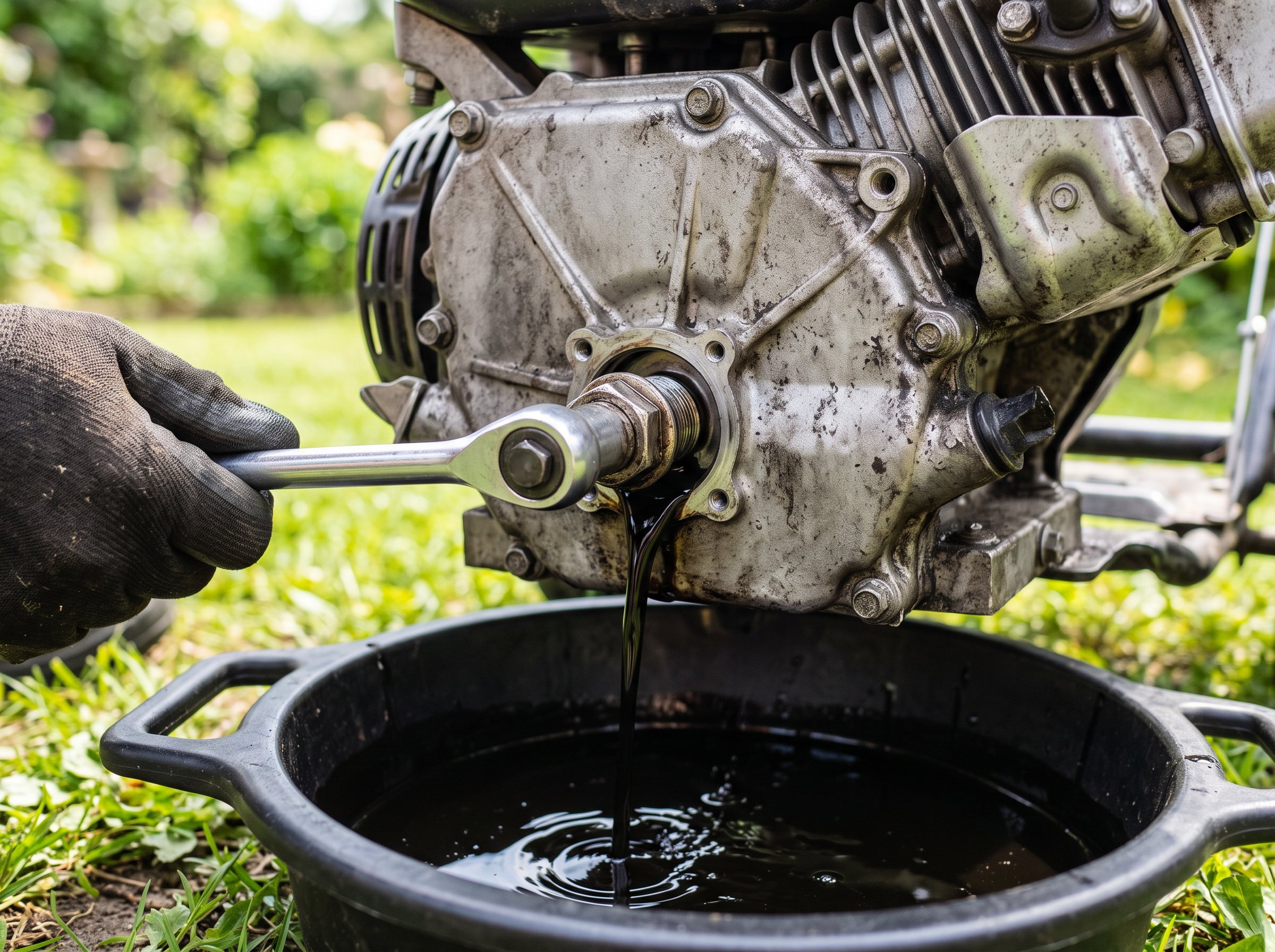
- Remove the drain plug (check your manual for location — it varies by model)
- Let oil drain completely for 5-10 minutes
- Replace the drain plug and tighten snugly (don't overtighten)
- Fill with fresh 5W-30 full synthetic motor oil — check your dipstick for the correct level
- Replace the oil filter if your mower has one (most push mowers don't; riding mowers usually do)
Why full synthetic? It provides better protection during the temperature swings of storage and flows immediately on spring startup, unlike conventional oil that thickens in cold storage.
Step 3: Clean the Mower Deck
Packed grass under the deck is a rust factory. It traps moisture against bare metal for months.
- Disconnect the spark plug wire for safety before working under the deck
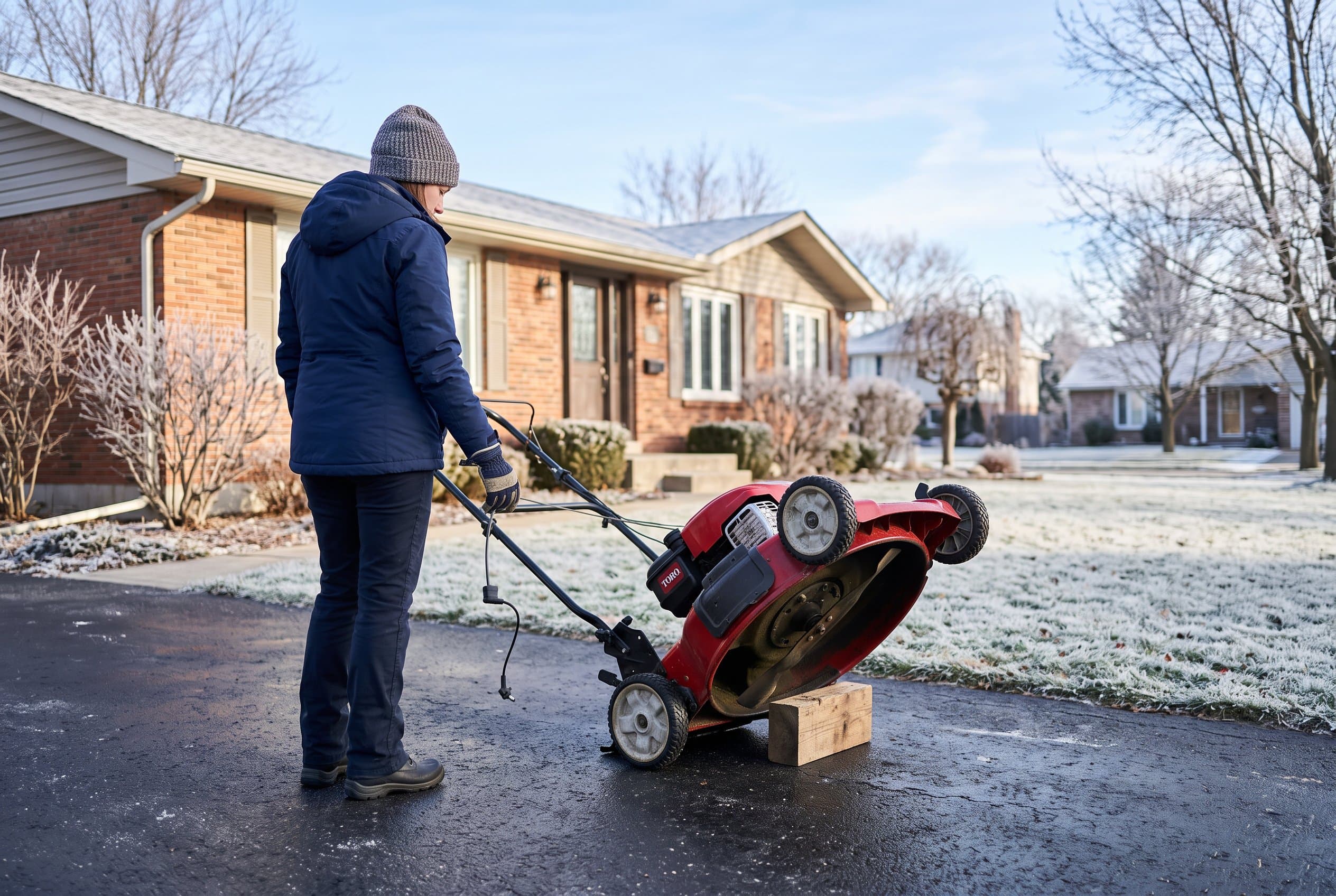
- Tip the mower on its side (air filter side up to prevent oil leaking into the filter)
- Use a putty knife or paint scraper to remove caked-on grass
- Spray the underside with a garden hose for remaining debris
- Let it dry completely — this is important, don't skip it
- Spray the clean, dry deck with WD-40 or silicone lubricant to create a protective barrier[2]
Step 4: Sharpen or Replace the Blade
Fall is the best time to handle blade maintenance so you're ready to mow the moment spring arrives.
Remove the blade (mark the bottom side so you reinstall it correctly). Inspect for:
- Cracks or large chips: Replace the blade entirely
- Minor nicks and dullness: Sharpen with a blade sharpener or bench grinder
- Bent blade: Replace — a bent blade causes vibration that damages the engine crankshaft
Sharpen at a 30-degree angle, maintaining equal material removal from both ends to keep the blade balanced. An unbalanced blade vibrates and wears out spindle bearings.
If the blade is beyond saving, order a replacement blade now while you're thinking about it.
Step 5: Service the Air Filter and Spark Plug
Air filter:
- Foam filters: Wash in warm soapy water, squeeze dry (don't wring), let air dry completely, then re-oil with clean engine oil
- Paper filters: Replace if dirty — they can't be effectively cleaned
- Dual-element filters (foam pre-filter over paper): Clean the foam, replace the paper if needed[5]
Spark plug:
- Remove and inspect. Look for black carbon buildup, oil fouling, or a worn electrode
- If the electrode is rounded or the gap is wrong, replace it ($3-5 for a new plug)
- Apply a small amount of oil into the spark plug hole
- Pull the starter cord 2-3 times to distribute oil across the cylinder walls
- Reinstall the spark plug (new or cleaned) and hand-tighten plus 1/4 turn with a wrench
Step 6: Protect Against Corrosion
After cleaning and servicing, apply protective coatings to prevent rust during storage:
- Spray exposed metal surfaces (deck, blade housing, handle hardware) with WD-40 or silicone spray
- Apply petroleum jelly to battery terminals if applicable
- Coat the blade with a thin layer of oil before reinstalling
- Wipe down painted surfaces to remove dirt that holds moisture
Pro move: Set the piston to top dead center. Pull the recoil rope slowly until you feel maximum resistance — this positions the piston at the top of its stroke, sealing both the intake and exhaust valves. This prevents moist air from entering the cylinder and causing internal corrosion during storage[4].
Step 7: Store Properly
Where and how you store the mower matters as much as the maintenance itself.
Ideal storage:
- Dry, well-ventilated garage or shed
- Off concrete if possible (concrete wicks moisture) — place on cardboard or a wooden pallet
- Cover with a breathable cloth tarp or old bed sheet (never plastic — it traps condensation)
- Away from furnaces, water heaters, or other ignition sources if fuel remains in the tank[3]
Battery storage (electric-start mowers):
- Remove the battery and bring it indoors
- Store on a wooden surface in a temperature-stable room (not an unheated garage)
- Connect to a trickle charger or charge monthly to prevent sulfation
- Clean terminals with a wire brush and apply anti-corrosion spray
Additional storage checklist:
- Keep the mower level to prevent oil from leaking into the air filter
- Check and inflate tires to proper PSI (low tires develop flat spots over winter)
- Lubricate wheels, cables, and pivot points with white lithium grease
Winterization Checklist (Print This)
| Step | Task | Time | Done? |
|---|---|---|---|
| 1 | Drain fuel or add stabilizer to fresh gas | 15 min | |
| 2 | Change oil (while engine is warm) | 10 min | |
| 3 | Clean mower deck and underside | 10 min | |
| 4 | Sharpen or replace blade | 10 min | |
| 5 | Service air filter and spark plug | 5 min | |
| 6 | Apply corrosion protection, set piston to TDC | 5 min | |
| 7 | Store in dry location with breathable cover | 5 min | |
| **Total** | **~45 min** |
Riding Mower vs. Push Mower: Key Differences
Riding mowers need a few extra steps beyond what's listed above:
- Fuel system: Same process, but riding mowers have fuel filters that should be replaced annually. Do it during winterization.
- Battery: Riding mower batteries are larger and more expensive ($40-80). A trickle charger is essential — don't let it sit all winter uncharged.
- Deck: Remove the deck if possible for more thorough cleaning. Inspect belt condition and replace if cracked or glazed.
- Transmission/Hydrostatic fluid: Check fluid levels according to your owner's manual. Some riding mowers need transmission fluid changes every 200 hours.
- Tire pressure: More critical on riding mowers — uneven pressure causes an uneven cut. Inflate to manufacturer specs.
Spring Startup After Winterization
When spring arrives, your properly winterized mower should start with minimal fuss. Pair a smooth startup with our essential spring lawn care tips and you'll be ahead of every neighbor on the block:
- Add fresh fuel if you drained the tank. Use ethanol-free gas if available in your area.
- Check oil level on the dipstick — top off if needed but don't overfill.
- Reconnect the spark plug wire.
- Prime the engine (3-4 presses of the primer bulb if your mower has one).
- Pull start or turn the key. A winterized mower should start within 1-3 pulls.
- Let it idle for 2-3 minutes before mowing to warm up and circulate oil.
If it doesn't start, check: spark plug connection, fuel in the tank, and the throttle/choke position. If you still can't start it, the most likely culprit is old fuel residue in the carburetor — which means the fuel draining step wasn't thorough enough[4].
Conclusion
Winterizing your lawn mower is the single best thing you can do to extend its life and avoid frustrating spring repairs. The 45-minute investment pays for itself many times over in reliable starts, better cutting performance, and a mower that lasts 10-15 years instead of 5-7.
Do this once, right after your last mow of the season, and you won't think about your mower again until the grass starts growing in spring. Make sure you've also finished preparing your lawn for winter and completed every task in our fall lawn maintenance guide before putting your tools away.
Sources
- University of Minnesota Extension - Small engine winterization and maintenance guidelines
2. Michigan State University Extension - Lawn equipment storage and maintenance best practices
3. Briggs & Stratton - Engine manufacturer winterization recommendations and research
4. Consumer Reports - Independent lawn mower maintenance testing and recommendations
5. Purdue University Extension - Turfgrass equipment care and seasonal maintenance