Quick Answer
Bentgrass varieties, particularly creeping bentgrass, are the gold standard for DIY putting greens due to their fine texture and ability to tolerate extremely low mowing heights. For warmer climates, hybrid bermuda grass offers excellent putting quality with better heat tolerance, while synthetic turf provides a low-maintenance alternative that performs consistently year-round.
Key Takeaways
- Creeping bentgrass provides the smoothest putting surface but requires intensive maintenance and cool weather
- Hybrid bermuda grass works best in warm climates and offers durability with good putting characteristics
- Synthetic turf eliminates seasonal variations and reduces long-term maintenance costs
- Proper soil preparation and drainage are critical regardless of grass type chosen
- Budget $3-8 per square foot for natural grass installation versus $8-15 for quality synthetic options
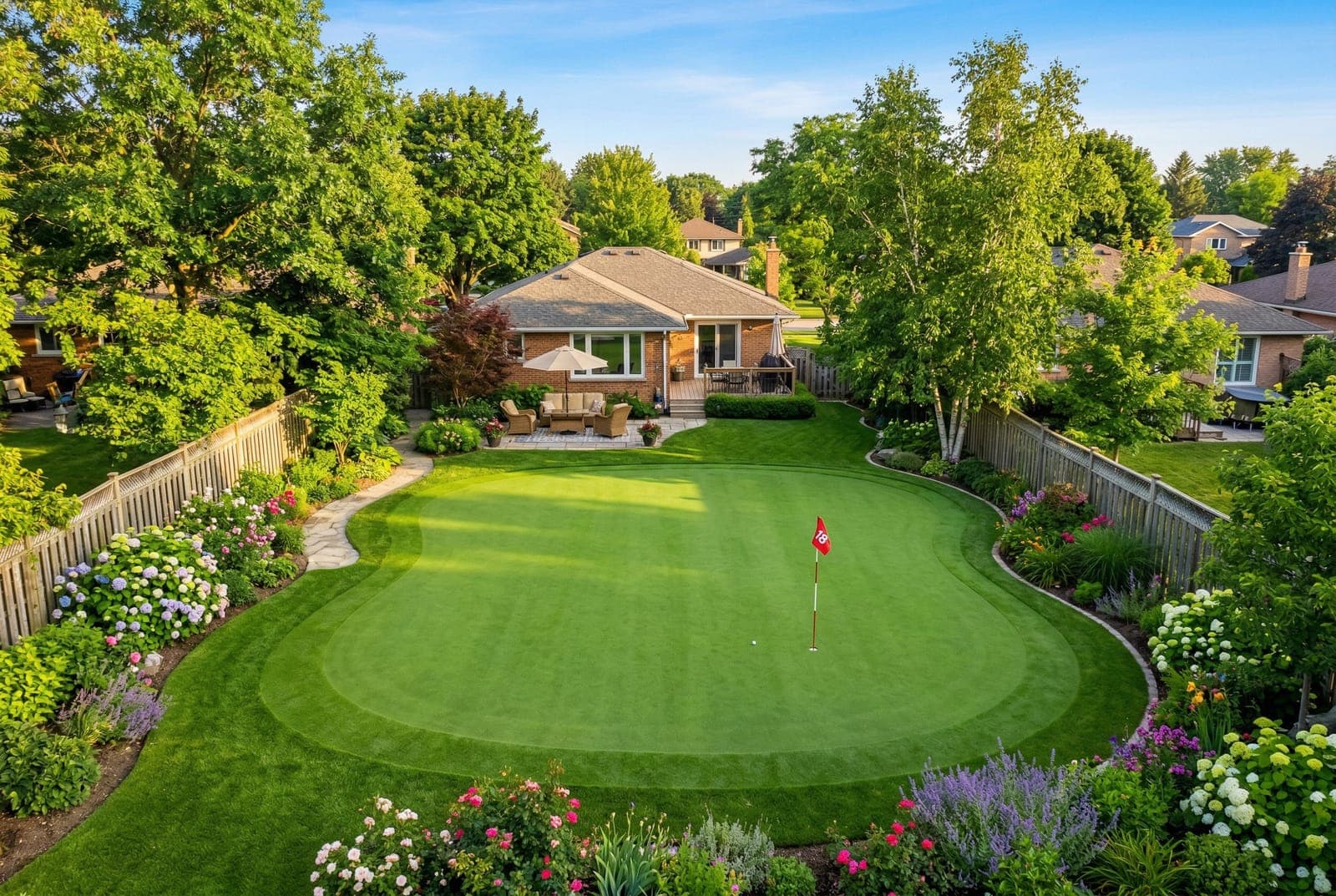
Creating a backyard putting green transforms your outdoor space into a personal golf practice area — and even a short daily putting routine can save you 3-5 strokes per round. For a full backyard putting green cost breakdown, see our detailed pricing guide. The grass variety you choose will determine not only the quality of your putting experience but also the maintenance requirements and long-term success of your project.
What Makes Grass Suitable for Putting Greens?
Putting green grass must meet specific performance criteria that differ significantly from regular lawn grass[1]. The ideal putting surface requires grass that can be mowed to 0.125 inches or lower while maintaining density and smoothness. This grass must also tolerate frequent foot traffic and provide consistent ball roll speed.
Putting Green Grass Varieties Compared
| Variety | Min. Mow Height | Climate | Maintenance Level | Ball Roll Quality | Cost/sq ft |
|---|---|---|---|---|---|
| Creeping bentgrass (Penncross) | 0.100 in | Cool (zones 3-7) | Very high | Excellent | $3–5 (sod) |
| Creeping bentgrass (L-93) | 0.100 in | Cool (zones 3-7) | Very high | Excellent | $3–5 (sod) |
| Hybrid bermuda (Tifdwarf) | 0.125 in | Warm (zones 8-11) | High | Very good | $2–4 (sprigs) |
| Hybrid bermuda (Champion) | 0.125 in | Warm (zones 8-11) | High | Very good | $3–5 (sprigs) |
| Bermuda (419) | 0.250 in | Warm (zones 7-11) | Moderate | Good | $1–3 (sod) |
| Fine fescue | 0.500 in | Cool (zones 3-7) | Low | Fair | $1–2 (seed) |
| Synthetic turf (nylon) | N/A | Any | Very low | Good–Excellent | $8–15 |
Creeping bentgrass stands out as the premier choice because of its fine leaf texture and ability to form a dense, carpet-like surface when properly maintained[2]. The grass grows horizontally through stolons, creating the tight mat necessary for consistent ball movement — which matters because speed control accounts for roughly 80% of putting success. However, bentgrass thrives in temperatures between 60-75°F and struggles in hot, humid conditions.
For warm-season regions, hybrid bermuda grass varieties like Tifdwarf and Champion offer excellent alternatives. These grasses can tolerate the ultra-low mowing heights required for putting greens while withstanding heat and drought better than cool-season options[3]. Note that bermuda grass doesn't stripe as dramatically as cool-season grasses because its rigid blades spring back upright after mowing.
How Do You Install Natural Grass Putting Greens?
Successful installation begins with proper site preparation and soil modification. Excavate the area to 12-18 inches deep and install a drainage system using perforated pipes in a gravel base[4]. This prevents waterlogging that can kill putting green grass.
Create a specialized growing medium by mixing 70% sand with 30% organic matter, following USGA green construction guidelines. This mixture provides the drainage and stability needed for putting green grass while allowing root development[1]. The sand component should be angular rather than rounded for better compaction.
Pro tip: Use engineered topsoil (a compost-sand mix) rather than regular topsoil. Water moves through the soil profile much faster, and it stays firm yet fluffy — ideal for putting green root zones. Standard topsoil compacts too tightly and creates drainage problems.
Installation Timeline by Grass Type
| Step | Bentgrass | Bermuda | Timeline |
|---|---|---|---|
| Best planting window | Early fall | Late spring–early summer | 1 day |
| Seeding/sprigging rate | 1-2 lbs/1,000 sq ft | 5-10 bushels/1,000 sq ft | 1 day |
| Germination | 7-14 days | 7-14 days (sprigs root) | 2 weeks |
| First mow (high setting) | 3-4 weeks after germination | 3-4 weeks | Week 5-6 |
| Gradual height reduction | Lower 1/8 in per week | Lower 1/8 in per week | Weeks 6-14 |
| Playable condition | 3-4 months | 2-3 months | Months 3-4 |
| Full maturation | 6-12 months | 6-12 months | Year 1 |
For bentgrass installation, seed in early fall when temperatures consistently stay below 80°F. Apply seed at 1-2 pounds per 1,000 square feet and keep the surface consistently moist until germination occurs in 7-14 days[2]. Bermuda grass should be planted in late spring through early summer using sprigs or plugs for the best establishment.
Gradually lower your mowing height over several weeks, starting at 0.5 inches and working down to the final putting green height of 0.125-0.1875 inches. Use a reel mower designed for greens maintenance, as rotary mowers cannot achieve these cutting heights effectively[3]. Test your reel mower's sharpness by cutting a piece of paper — it should slice cleanly like scissors.
Soil Preparation for Putting Greens
The soil under a putting green is completely different from normal lawn soil. The USGA specification requires:
- Root zone mix: 80-85% sand, 15-20% organic matter (peat)
- Gravel drainage layer: 4 inches of pea gravel beneath the root zone
- Total depth: 12-16 inches of modified soil profile
- pH target: 6.0-6.5 for bentgrass, 6.0-7.0 for bermuda
Testing your soil before construction helps you determine how much modification is needed. If your native soil is heavy clay, you'll need to excavate the full depth. Sandy native soil may need less modification.
Why Consider Synthetic Turf for Your Putting Green?
Synthetic putting green turf offers compelling advantages for DIY installations, particularly for homeowners seeking consistent performance without intensive maintenance. Modern artificial turf designed specifically for putting greens features varying pile heights and infill systems that simulate true grass ball roll characteristics[4].
The installation process for synthetic turf is more straightforward than natural grass, requiring a stable base of crushed rock and sand rather than specialized growing medium. Quality synthetic putting surfaces can last 15-20 years with minimal maintenance beyond occasional brushing and debris removal. For the full installation walkthrough, see our DIY chipping green guide.
Natural vs. Synthetic: Honest Pros and Cons
| Factor | Natural Grass | Synthetic Turf |
|---|---|---|
| Putting feel | Authentic, varies with conditions | Consistent, slightly different |
| Year-round use | No (dormancy, weather) | Yes |
| Daily maintenance | 30-60 minutes | None |
| Weekly maintenance | Mow, water, treat | 15-20 min brushing |
| Equipment needed | Greens mower ($800-2,000+) | Stiff broom |
| Lifespan | Indefinite with care | 15-20 years |
| Break-even point | — | 3-5 years (vs natural maintenance costs) |
Cost considerations favor synthetic turf for smaller installations, as the higher upfront investment ($8-15 per square foot) eliminates ongoing expenses for specialized fertilizers, frequent watering, and equipment maintenance that natural grass requires[5]. Synthetic options also allow year-round use regardless of weather conditions. See our putting green cost breakdown for detailed pricing by method.
What Maintenance Does Natural Grass Putting Green Require?
Natural grass putting greens demand significantly more care than a regular lawn. Understanding the commitment before choosing natural grass prevents frustration down the road.
Daily: Water lightly (called "syringing") during hot weather to prevent wilt. Check for disease symptoms — catching fungal issues early is critical at putting green heights where grass is already stressed.
Every 1-2 days: Mow with a sharp reel mower. At 1/8 inch height, grass grows past the ideal cutting height quickly. Missing even 2-3 days during peak growing season can set you back weeks.
Weekly: Apply liquid fertilizer at low rates. Putting greens need frequent, light feedings rather than the heavy applications used on lawns. Use fertilizer with tiny prill size designed for greens turf to ensure even distribution through the dense canopy.
Monthly: Topdress with fine masonry sand to smooth the surface and prevent scalping. Use a conditioning bar on your mower to cut through thatch and promote air circulation.
Seasonally: Aerate in spring and fall to relieve compaction. Overseed bentgrass in early fall, or overseed bermuda with perennial ryegrass for winter color.
The reason homeowners can maintain a backyard putting green without professional training is simple: you have one small green rather than eighteen 3,000-5,000 square foot greens. The smaller scale makes intensive maintenance manageable.
Which Option Works Best for Your Climate?
Your local climate plays the determining role in grass selection success. Cool-season regions with moderate summers (zones 3-7) provide ideal conditions for bentgrass putting greens. These areas offer the temperature stability bentgrass needs while avoiding the heat stress that causes summer dormancy or death[2].
Warm-season climates (zones 8-11) require bermuda grass varieties or synthetic alternatives. Bermuda grass enters dormancy in winter, turning brown until spring temperatures return, which limits year-round putting practice. However, overseeding with perennial ryegrass can maintain green color and playability during dormancy periods[3].
Transition zones present the greatest challenge, as neither cool nor warm-season grasses perform optimally year-round. Homeowners in these areas often find synthetic turf provides the most reliable solution for consistent putting green performance[5].
Conclusion
Choose creeping bentgrass for cool climates where you can commit to intensive maintenance, or select hybrid bermuda grass for warm regions with seasonal dormancy acceptance. Synthetic turf offers the most practical solution for consistent year-round performance with minimal upkeep. Start your project by testing soil drainage and researching local suppliers for your chosen grass type or synthetic product. You might also consider building a DIY chipping green alongside your putting surface (knowing when to chip versus pitch will help you get the most out of it), adding a backyard tee box for a complete practice facility, and making your whole lawn look like a golf course. Plan installation timing carefully — fall for bentgrass, late spring for bermuda grass, or any season for synthetic options.