Quick Answer
Drive XLR8 Herbicide Accelerate proved most effective in independent head-to-head testing, killing mature crabgrass within 24 hours. Products containing quinclorac as the active ingredient consistently outperform general-purpose herbicides like Tenacity for crabgrass control.
Key Takeaways
- Pre-emergent (spring, before germination) is always more effective and cheaper than post-emergent — start there
- Quinclorac-based herbicides like Drive XLR8 Accelerate work fastest for post-emergent control — visible kill in 24 hours
- Ortho Weed B Gon offers decent results and wider availability at big box stores
- Tenacity, despite its popularity, shows limited effectiveness against established crabgrass post-emergent (it's best pre-emergent during overseeding)
- Adding a surfactant is non-negotiable — it can double your herbicide's effectiveness
- Proper crabgrass identification is crucial before treatment
- Check grass-type safety before applying: quinclorac harms St. Augustine and centipede; mesotrione harms all warm-season grasses
Pre-Emergent vs. Post-Emergent: Pick Your Strategy
Before choosing a product, know where you are in the season — the two approaches work at completely different points in the crabgrass life cycle.
Pre-emergent herbicides create a chemical barrier in the soil that prevents crabgrass seeds from germinating. They must be applied before soil temperatures at 2-inch depth reach 55°F — typically late winter to early spring depending on your zone. Apply too late and germination has already begun; the barrier is useless once crabgrass is actively growing. Prodiamine (Prodiamine 65 WDG, Barricade) and pendimethalin (Scott's Halts, Scotts Turf Builder with Halts) are the two most-used pre-emergent active ingredients. Both provide 4–6 months of residual protection when watered in properly.
Post-emergent herbicides kill crabgrass that is already growing. They require the plant to be actively photosynthesizing for uptake — hence the temperature windows (60–90°F). You're playing catch-up against actively growing plants. Results are reliable but require surfactant and proper timing, and you'll still need to fill in the bare spots after the plant dies.
The better default strategy: if it's still early spring and you haven't seen any crabgrass yet, start with a pre-emergent. If you're already looking at green crabgrass plants, go post-emergent. For a complete timing guide see when to apply crabgrass preventer.
How to Identify Crabgrass in Your Lawn
Before choosing any treatment, proper identification is essential. Misidentifying your weed means wasting money on the wrong herbicide.
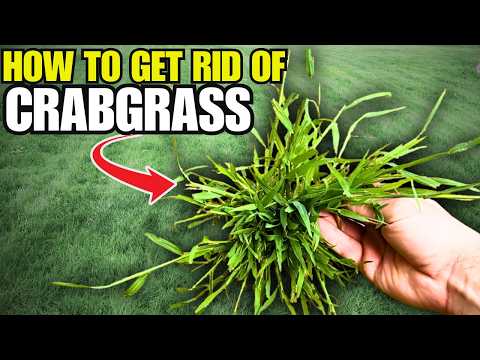
What crabgrass looks like: Thick, coarse blades with a lime green color that's noticeably lighter than surrounding turf. It grows in a distinctive star-shaped, spreading pattern close to the ground. Each plant can produce 150,000+ seeds per season[1].
Where it grows: Crabgrass thrives in hot, sunny areas and becomes particularly aggressive during late summer. It establishes itself in thin or bare spots where your regular grass struggles to compete — along driveways, sidewalk edges, and areas with compacted soil.
Common look-alikes: Don't confuse crabgrass with tall fescue clumps (which grow upright, not flat), dallisgrass (which has a distinctive midrib), or quackgrass (which has clasping auricles at the base of each blade). If you're unsure, pull a sample and check: crabgrass pulls out easily with shallow roots, while most look-alikes have deeper root systems.
When it appears: Crabgrass is an annual weed that germinates when soil temperatures consistently reach 55°F at a 2-inch depth — typically late April through May depending on your region. It dies with the first hard frost, but the seeds it drops survive winter to start the cycle again.
How the Side-by-Side Test Was Run
The product-performance data in the next section comes from independent field testing documented by Suburban Acreage (video N8Bb6-ASUR8[4]). The Suburban Acreage channel (440,000+ views on this video) is an independent lawn-care creator; neither this site nor the products tested sponsored the video.
What the test showed: Mature, actively growing crabgrass treated under peak summer conditions (temperatures in the 70–85°F range, mid-season growth stage). Each product was applied at manufacturer label rates using a pump sprayer with a non-ionic surfactant added. Results were observed and photographed at 24h, 48h, 7d, and 21d intervals.
What the test did not cover: Pre-emergent performance, warm-season grass safety, or performance on crabgrass seedlings (pre-tiller stage). This is a post-emergent-only comparison under typical residential conditions. For a laboratory comparison of active ingredients and grass-type safety, see the Safety Matrix further down this page.
How Three Products Performed in Independent Testing
The field test results summarized below come from independent testing by the Suburban Acreage channel, applied to mature, actively growing crabgrass under peak summer conditions. Application rates and timing reflect manufacturer label instructions. Here's how the three products compared.
Product Comparison at a Glance
| Product | Active Ingredient | Kill Speed | Effectiveness | Availability | Price Range |
|---|---|---|---|---|---|
| Drive XLR8 Accelerate | Quinclorac | 24 hours | Excellent | Online, landscape supply | $$$ |
| Ortho Weed B Gon | Quinclorac + 2,4-D | 3-5 days | Good | Big box stores | $$ |
| Tenacity (Mesotrione) | Mesotrione | 2-3 weeks | Poor on crabgrass | Online | $$$ |
Drive XLR8 Herbicide Accelerate: The Professional Choice
Drive XLR8 Herbicide Accelerate has earned its reputation as the go-to choice among lawn care professionals and serious DIY enthusiasts. While you won't find it at your local Home Depot, it's readily available through landscape supply stores or online retailers.
The active ingredient quinclorac makes this product uniquely effective against grassy weeds. Unlike broadleaf herbicides that target dicot weeds, quinclorac disrupts the growth hormones specific to grassy weeds like crabgrass, goosegrass, and foxtail.
Field test results: Within 24 hours, treated crabgrass showed dramatic yellowing. By 48 hours, plants were visibly wilting and curling. Complete browning occurred within 5-7 days — the fastest kill of any product tested.
How to use it: Mix at 0.367 oz per gallon of water per 1,000 sq ft. Always add a non-ionic surfactant (more on this below). Apply when crabgrass is actively growing and temperatures are between 60-90°F. Avoid mowing for 2 days before and after application.
The downside: It requires mixing (it's a concentrate, not ready-to-spray), and it's selective only for grassy weeds — you'll still need a separate product for dandelions and clover.
Ortho Weed B Gon: The Convenient Compromise
For homeowners who prefer the convenience of big box store shopping, Ortho Weed B Gon offers a solid middle-ground option. Available at Walmart, Home Depot, and Lowe's, this ready-to-spray herbicide also contains quinclorac.
Field test results: Visible yellowing began at day 2-3, with significant dieback by day 7. Not as fast as Drive XLR8, but solid performance considering the convenience factor.
The advantage: It combines quinclorac with 2,4-D and dicamba, so it kills broadleaf weeds alongside crabgrass. If your lawn has crabgrass, dandelions, and clover, this one bottle handles all three. The ready-to-spray versions need no mixing.
The downside: The combined formula means lower quinclorac concentration per application compared to Drive XLR8. You may need a second application for heavily established crabgrass.
Tenacity: The Overrated Option
Despite its massive popularity on social media and lawn care forums like r/lawncare, Tenacity shows surprisingly limited effectiveness against established crabgrass. This is the product that generates the most disappointment among homeowners who buy it expecting a miracle cure.
Field test results: After 7 days, treated crabgrass turned white (Tenacity's signature bleaching effect) but showed minimal actual death. After 14 days, some plants began to recover. After 21 days, several treated plants had returned to normal growth. The bleaching looks dramatic but often masks the fact that the plant is still alive.
Where Tenacity actually excels: It's an outstanding pre-emergent when applied during seeding (it won't harm new grass seedlings, unlike most herbicides). It's also effective against broadleaf weeds like nimblewill, bentgrass, and certain sedges. Use it for those purposes — not for killing established crabgrass.
Why it fails on crabgrass: Mesotrione (Tenacity's active ingredient) inhibits pigment production, which is why weeds turn white. But crabgrass is resilient enough to survive this stress and resume normal growth once the chemical breaks down. Quinclorac, by contrast, causes irreversible hormone disruption.
Selective vs. Nonselective: Why This Distinction Matters
Not all herbicides are "safe on lawns." Understanding selectivity before you spray is what protects your desirable grass.
Selective herbicides target specific plant types and leave others unharmed at label rates. All three tested products are selective — they target grassy weeds (quinclorac) or inhibit pigmentation in broadleaf weeds and certain grasses (mesotrione) without killing your turf, when applied to compatible grass types.
Nonselective herbicides (glyphosate, glufosinate) kill any green plant they contact. Never use these for crabgrass spot treatment in an active lawn — they will brown out your entire turf.
The critical nuance: selective does not mean universally safe. Quinclorac is selective for warm-season lawns like Bermuda and zoysia — but unsafe on St. Augustine and centipede. Mesotrione is safe for cool-season grass — but kills or severely damages warm-season turf at label rates. Applying the wrong selective herbicide to the wrong turf type is one of the most common "why did my lawn die?" mistakes.
Grass Type Safety Matrix {#grass-type-safety-matrix}
Check your grass type before applying. The table below is sourced from manufacturer product labels — always verify against the current label before purchase, as formulations change.[5]
| Grass Type | Drive XLR8 (Quinclorac) | Ortho Weed B Gon (Quinclorac + 2,4-D) | Tenacity (Mesotrione) |
|---|---|---|---|
| Kentucky Bluegrass | ✅ Safe | ✅ Safe | ✅ Safe |
| Tall Fescue | ✅ Safe | ✅ Safe | ✅ Safe |
| Perennial Ryegrass | ✅ Safe | ✅ Safe | ✅ Safe |
| Fine Fescue | ⚠️ Check label | ⚠️ Check label | ✅ Safe |
| Bermudagrass | ✅ Safe | ✅ Safe | ❌ Do not use |
| Zoysiagrass | ✅ Safe | ✅ Safe | ❌ Do not use |
| St. Augustinegrass | ❌ Do not use | ❌ Do not use | ❌ Do not use |
| Centipedegrass | ❌ Do not use | ❌ Do not use | ❌ Do not use |
| Buffalograss | ⚠️ Check label | ❌ Do not use | ❌ Do not use |
If you have St. Augustine or centipede, you need a different product entirely — look for Atrazine (for St. Augustine) or MSMA where still legal. See the warm-season grass weed control guide for turf-safe options.
Application Tips for Maximum Effectiveness
The Surfactant Secret (Don't Skip This)
One crucial factor that separates successful applications from wasted product: always add a surfactant. This is non-negotiable.
Crabgrass leaves have a natural waxy coating that repels water — similar to a freshly waxed car. Without a surfactant, your herbicide beads up and rolls off the leaf instead of being absorbed. A non-ionic surfactant breaks this surface tension and forces the product to spread across the leaf surface[2].
Application rate: Add surfactant at 0.25-0.5% of total spray volume (about 1-2 teaspoons per gallon). More isn't better — excessive surfactant can damage grass.
Dish soap alternative: In a pinch, a few drops of non-degreasing dish soap works, but commercial non-ionic surfactant is more consistent and less likely to harm your turf.
Spray Technique That Matters
Target the weed, not the lawn. Use a fan-tip nozzle for even coverage across crabgrass patches rather than a pinpoint stream. Coat the leaves until they're wet but not dripping — excess product runs off and wastes money.
Time of day: Apply in early morning or late afternoon when temperatures are moderate. Avoid midday heat above 85°F, which can cause rapid evaporation before the herbicide absorbs. Also avoid application if rain is forecast within 4 hours.
Proper equipment: While a basic pump sprayer works, a battery-powered backpack sprayer maintains consistent pressure without manual pumping. This matters for even coverage across large areas.
When to Expect Results
| Product | First Signs | Significant Kill | Complete Kill |
|---|---|---|---|
| Drive XLR8 | 24 hours (yellowing) | 3-5 days | 7-10 days |
| Ortho Weed B Gon | 2-3 days | 5-7 days | 10-14 days |
| Tenacity | 3-5 days (bleaching) | Partial at best | Often incomplete |
Large, mature crabgrass plants with established root systems take longer to die than young seedlings. If plants are larger than your fist, consider a second application 10-14 days after the first.
Cost Per 1,000 Sq Ft: What You'll Actually Pay
Container price hides the real economics. What matters is cost per application across your treated area. Here's the math based on label rates for a single post-emergent application at full strength on actively growing crabgrass.
| Product | Container Size | Typical Price | Label Rate | Cost / 1,000 sq ft | Notes |
|---|---|---|---|---|---|
| Drive XLR8 Accelerate | 64 oz concentrate | ~$95 | 0.367 oz / 1,000 sq ft | ~$0.55 | Add ~$0.05 surfactant |
| Ortho Weed B Gon Plus Crabgrass | 32 oz concentrate | ~$22 | 1 oz / 1,000 sq ft | ~$0.69 | Includes 2,4-D + dicamba |
| Ortho Weed B Gon (ready-to-spray) | 32 oz hose-end | ~$15 | 32 oz covers ~3,000 sq ft | ~$0.50 | No mixing, slightly weaker |
| Tenacity | 8 oz concentrate | ~$80 | 0.18 oz / 1,000 sq ft | ~$2.25 | Cheapest *only if* it actually kills the weed |
| Prodiamine 65 WDG (pre-emergent) | 5 lb bag | ~$60 | 0.184 oz / 1,000 sq ft (split app) | ~$0.14 per 1,000 sq ft | Applied *before* germination; covers 5,000–10,000 sq ft per bag |
Drive XLR8's per-application cost looks low because the concentrate goes far — one 64 oz jug treats roughly 175,000 sq ft at label rate. For a typical 5,000 sq ft suburban lawn doing two summer spot-treatments, you'd use under 4 oz total and the jug lasts multiple seasons.
Tenacity's effective cost is misleading on the label alone. If you have to retreat (or the crabgrass survives entirely), the real cost-per-killed-plant climbs sharply. For more on building a full-season weed plan, see our overview of weed control methods by mode of action.
Application Calendar by USDA Zone
Crabgrass germination tracks soil temperature, not the calendar. The 55°F-at-2-inch threshold lands at very different dates depending on where you live. Use this as a planning guide and confirm with a local soil thermometer reading.
| Zone | Region (examples) | Pre-emergent window | Post-emergent peak | Last effective spray |
|---|---|---|---|---|
| 4-5 | Upper Midwest, New England | Late April – mid May | July – early August | Early September |
| 6 | Mid-Atlantic, Ohio Valley | Late March – late April | June – August | Mid-September |
| 7 | Mid-South, Pacific Northwest | Mid-March – mid-April | June – September | Late September |
| 8 | Lower South, Texas | Late February – March | May – September | Mid-October |
| 9-10 | Gulf Coast, Florida, Southern California | February (first app) | April – October | November |
In the South, a split pre-emergent — half-rate in late winter and another half-rate 8-10 weeks later — is more effective than a single heavy spring application. The reason: warm-zone soils stay in the germination range for 5+ months, well past a single application's residual life. For a deeper southern-lawn approach, see our southern lawn weed control guide.
Soil-Temperature Timing for Pre-Emergent
The calendar table above is a proxy. For precision timing, use a soil thermometer at a 2-inch depth:
- Apply pre-emergent at 50–53°F — before crabgrass seeds begin to activate.
- Window closes at 65°F — above this, germination is underway and pre-emergent will not help.
- Regional shortcut: in most of the country, crabgrass germinates 1–2 weeks after forsythia blooms. If forsythia is leafing out in your neighborhood, your window has opened.
Why soil temperature matters more than air temperature: soil warms 2–4 weeks after air temperatures rise in spring, and cools 2–4 weeks after fall air-temperature drops. A warm March followed by a cold snap can delay soil warming significantly, making "soil temp at planting depth" the only reliable gate.
Most lawn centers sell soil thermometers for under $15. For guidance on checking the exact soil-temperature timing for pre-emergent crabgrass control, see our dedicated guide.
If you missed the pre-emergent window entirely, you're not out of options — read how to kill crabgrass without pre-emergent before reaching for the strongest product.
Common Application Mistakes That Kill Results (Not Crabgrass)
Across hundreds of "why didn't this work?" threads on r/lawncare and university extension Q&As, the same five mistakes show up repeatedly:
- Spraying too late in the day on hot afternoons. Surface temperatures above 85°F cause the carrier water to evaporate before the herbicide is absorbed. Early morning or after 6 PM is the safe window.
- Skipping the surfactant. Already covered above, but worth repeating: a $12 bottle of non-ionic surfactant is the single highest-leverage purchase in your crabgrass program.
- Mowing within 48 hours either side of application. Mowing before reduces leaf surface area; mowing after removes the treated leaf tissue before the herbicide moves systemically.
- Mixing herbicide too far in advance. Quinclorac and 2,4-D both degrade in solution. Mix only what you'll use within 2-4 hours.
- Treating crabgrass that's already gone to seed. Late-August crabgrass with visible seed heads is on its way out anyway — and the seeds are already in the soil for next year. At that point, mowing low and prioritizing fall pre-emergent timing matters more than another spray.
For preventing the pre-emergent miss in the first place, our piece on when to apply crabgrass preventer covers the soil-temperature signal homeowners most often get wrong.
The Smarter Strategy: Prevention vs. Cure
Post-emergent crabgrass control is always harder and more expensive than prevention. Here's the full-year approach:
Early Spring (soil temp 50-55°F): Apply pre-emergent herbicide before crabgrass germinates. Products containing prodiamine or dithiopyr create a chemical barrier that prevents seedlings from establishing. This single application prevents 80-90% of your crabgrass problem[3].
Late Spring (split application): Apply a second, lighter pre-emergent application 8-10 weeks after the first to extend the barrier through the full germination window.
Summer (when crabgrass is visible): Spot-treat breakthrough plants with quinclorac-based post-emergent. Don't blanket-spray your entire lawn — target individual crabgrass plants.
Fall: Overseed bare spots left by dead crabgrass. Thick, healthy turf is the best long-term crabgrass prevention. Crabgrass can't compete with established grass for light and resources.
After the Crabgrass Dies: What to Do Next
Dead crabgrass leaves unsightly brown patches in your lawn. Don't just ignore them — these bare spots are exactly where new weeds will establish next season.
Wait 2-3 weeks after herbicide application before doing anything. Some products have soil residual activity that inhibits new grass growth. Check your product label for reseeding intervals.
Rake out dead material to expose soil. Crabgrass debris can form a mat that blocks new seed-to-soil contact.
Overseed in fall for cool-season lawns (September-October is ideal). For warm-season lawns, plug or sprig in late spring when warm-season grasses are actively growing.
Improve conditions that allowed crabgrass in the first place: aerate compacted soil, adjust mowing height to 3-3.5 inches (taller grass shades out crabgrass seedlings), and address thin areas with overseeding.
Recommendation
For serious crabgrass problems: Drive XLR8 Accelerate with a non-ionic surfactant. It's the professional choice for a reason — quinclorac is simply the most effective post-emergent active ingredient for grassy weeds.
For mixed weed problems: Ortho Weed B Gon if you also have dandelions, clover, and other broadleaf weeds alongside crabgrass. One product handles everything.
For prevention: Apply a pre-emergent in early spring and maintain thick, healthy turf. This is always the better strategy than fighting established crabgrass in July.
For a broader view of how crabgrass control fits into a full weed-management program — including the cool-season weeds you might be fighting alongside it — start with our weed control topic hub.