If you've spotted brown, spongy patches that lift up like loose carpet, white C-shaped larvae are almost certainly chewing through your grass roots — and you don't have to reach for a chemical to stop them. (If the blades are chewed short but the turf is still anchored, you're probably looking at sod webworms instead — run through our grub vs sod webworm ID checks before you buy live nematodes for the wrong pest.) Beneficial nematodes are microscopic, soil-dwelling worms that hunt and kill lawn grubs from the inside out. Used correctly, they cut grub populations sharply within 7 to 14 days, and they're safe around kids, pets, earthworms, and pollinators.
This guide walks through the one nematode species that actually works on grubs, exactly when to apply it, how much to use, and the storage and chemical-compatibility rules that trip up most first-time buyers.
TL;DR
- The grub-killing nematode is Heterorhabditis bacteriophora (Hb). Skip products that only contain Steinernema feltiae — those target different pests.
- Apply when soil temperature is 60–95 °F, in the evening or on a cloudy day, then water in immediately and keep the soil moist for 7–14 days.
- Standard dose for grubs: 10 million infective juveniles per 1,000 sq ft (one "lawn-size" package from most reputable suppliers).
- Nematodes are live animals. Refrigerate on arrival, apply within 2 weeks, and never apply within 2 weeks of a chemical insecticide or systemic fungicide.
What are beneficial nematodes — and why Heterorhabditis bacteriophora?
Beneficial nematodes are naturally occurring soil organisms about 1 mm long — you can't see them without a hand lens. They actively hunt insect larvae in the top inch or two of soil, enter through natural body openings, and release a bacterium that kills the host within 24 to 48 hours. The nematodes then reproduce inside the cadaver and release a new generation that goes looking for the next grub.
There are several commercial nematode species, but only one is the right tool for lawn grubs:
- Heterorhabditis bacteriophora (Hb) — the species you want. Hb is a "cruiser" that actively searches deeper in the soil profile, which is exactly where Japanese beetle, masked chafer, European chafer, and June beetle grubs feed on grass roots.
- Steinernema feltiae (Sf) — targets fungus gnats, thrips, and other surface pests. Not effective against grubs.
- Steinernema carpocapsae (Sc) — an "ambusher" that sits near the surface; works on sod webworms and cutworms, not on the grubs eating your roots.
If a product lists only Sf or Sc, set it aside. For a head-to-head against the older biological option, see our milky spore vs chemical grub killer comparison — milky spore has a much narrower host range (Japanese beetle only) and works on a longer timeline.
When to apply beneficial nematodes
Timing is the single biggest reason nematode applications fail. Three rules:
- Soil temperature between 60 and 95 °F, measured 2 inches deep. Below 60 °F nematodes go dormant; above 95 °F they cook. In most US lawns, this means late spring through early fall — typically late May through September in cool-season turf zones, and April through October in warm-season zones.
- Apply in the evening or on an overcast day. UV light kills nematodes within minutes of exposure. Never apply in direct midday sun.
- Target the right grub life stage. Young, small grubs near the soil surface in late summer (August–September) are the easiest to kill. Large overwintered grubs in early spring are still susceptible but take longer to die.
For a deeper read on grub-treatment timing across regions and product types — chemical, biological, and preventer vs. curative — see our hub guide, when to apply grub killer.
How to apply beneficial nematodes (step-by-step)
- Buy live nematodes from a reputable supplier and refrigerate immediately. Look for a sealed package marked Heterorhabditis bacteriophora with a use-by date within the next 2–4 weeks. Store at 38–42 °F (standard refrigerator) until application day. Never freeze.
- Water the lawn deeply the day before applying. Nematodes travel through a thin film of water in the soil; a dry lawn shortens their working life dramatically.
- Mix the nematodes into water at application time. Empty the package into a clean bucket, stir gently to suspend the nematodes (don't shake hard), then transfer to a hose-end sprayer, backpack sprayer, or watering can. Use the entire package within 2 hours of mixing.
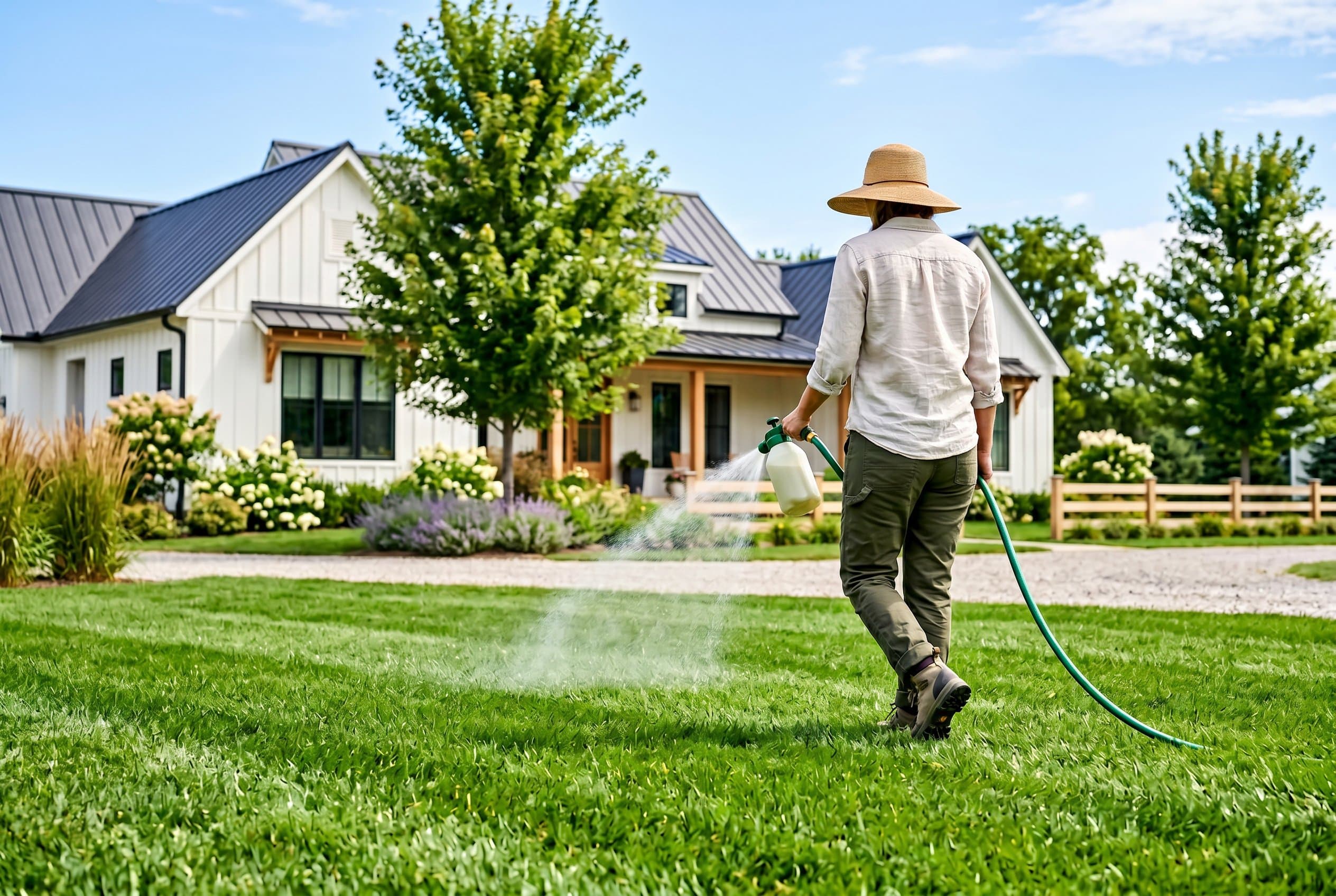
- Spray in the evening or on a cloudy day. Cover the entire treatment area evenly. Walk a slow, overlapping pattern — uniform coverage matters more than precise dosing.
- Water in for at least 30 minutes right after spraying. This is non-negotiable: nematodes left on the leaf blade will die within minutes once the sun returns. The goal is to push them into the top 1–2 inches of soil where the grubs feed.
- Keep the top 2 inches of soil moist for 7–14 days. Water lightly every morning, or every other morning, depending on temperature and rainfall. Drying out kills the nematodes before they can hunt — see our spring lawn watering schedule for a daily watering cadence that works for nematode follow-up.
How much to use (dosing)
For lawn grub control, the published standard is 10 million infective juveniles per 1,000 sq ft. Most suppliers package nematodes in "lawn-size" units that match this rate. For heavy infestations or compacted soil, double the rate on the worst patches; do not exceed twice the label rate.
Where to buy beneficial nematodes
Look for a vendor that ships nematodes overnight or 2-day, in an insulated cold pack, with a clearly marked species ID and use-by date. Two reliable Amazon listings to start with:
- NemaSeek Hb (Arbico Organics, sold on Amazon) — straight Heterorhabditis bacteriophora, packaged for grub control.
- BioLogic Scanmask / Heteromask — Hb formulation, widely stocked.
If you're still deciding between biological and chemical control, our best grub killer for lawns roundup compares specific products head-to-head with cost-per-1,000-sq-ft math.
What not to do — chemical compatibility and common mistakes
- Do not apply within 2 weeks of a chemical insecticide or systemic fungicide (imidacloprid, chlorantraniliprole, trichlorfon, propiconazole, etc.). Residues will kill the nematodes on contact. Wait the full window in both directions: 2 weeks after a chemical, 2 weeks before reaching for one.
- Do not apply through a sprayer with hot or chlorinated water. Room-temperature, dechlorinated water only.
- Do not skip the water-in step. This is the #1 reason DIY nematode applications fail.
- Do not store opened packages. Once mixed, the nematodes are committed.
Keep reading: When to apply grub killer · Best grub killer for lawns · Grub vs sod webworm: how to tell them apart · Milky spore vs chemical grub killer · How to fix bare spots in lawn · Spring lawn watering schedule