

Quick Answer
This lawn fertilizer schedule for Ohio homeowners covers cool-season lawns with 3–4 applications per year, with the most important applications in fall (September and November) and a lighter feeding in spring (late April to early May)[1]. Because Ohio's USDA hardiness zones 5b–6b bring cold winters, warm humid summers, and around 39 inches of annual rainfall, timing your fertilizer applications around the grass's natural growth cycles is critical for a healthy, stress-resistant lawn.
Key Takeaways:
- Fall fertilization (September–November) is the highest priority for Ohio's cool-season grasses
- Avoid heavy nitrogen applications in summer when heat and humidity trigger Brown patch disease
- Apply your first spring feeding no earlier than late April, after the soil warms and grass actively grows
- Use slow-release nitrogen fertilizers in summer if needed to reduce disease pressure
- Always follow Ohio's soil test recommendations from Ohio State University Extension before fertilizing
Ohio's continental climate creates a unique set of challenges for lawn care. Summers regularly push into the low-to-mid 80s°F with moderate-to-high humidity, stressing cool-season grasses like Kentucky Bluegrass, Tall Fescue, Perennial Ryegrass, and Fine Fescue[1]. Winters vary significantly across the state — northern Ohio near Lake Erie experiences harsher freeze-thaw cycles and lake-effect snow, while southern Ohio along the Ohio River sees milder winters. Getting your fertilizer schedule right means working with these regional conditions — not against them.
Ohio Lawn Fertilizer Schedule: Season-by-Season Timing Guide
The fertilizer schedule for Ohio lawns follows the growth patterns of cool-season grasses, which thrive in spring and fall and slow down significantly during summer heat[2].
Spring: Late April to Early May
Resist the urge to fertilize as soon as snow melts. Ohio lawns in zones 5b–6b aren't actively growing until soil temperatures consistently reach 50–55°F, which typically happens in late April[1]. A light application of a balanced fertilizer (such as a 20-5-10 formula) at this time supports green-up without pushing excessive leafy growth that leaves grass vulnerable to disease.
- Apply no more than 0.5–0.75 lbs of nitrogen per 1,000 sq ft
- Pair your spring feeding with a pre-emergent herbicide when forsythia blooms (typically early-to-mid April) to help prevent Crabgrass germination — though forsythia bloom is a useful phenological indicator, the most reliable trigger is a soil thermometer reading of 50–55°F at 2-inch depth, since bloom timing can vary by microclimate[3]
- Skip a spring feeding altogether if you applied a heavy late-fall fertilizer the previous November
Early Summer: Late May to Early June (Optional)
A light, slow-release nitrogen application in late May or early June can help Tall Fescue and Kentucky Bluegrass maintain color heading into summer[4]. Keep rates low — no more than 0.5 lbs of nitrogen per 1,000 sq ft — and choose a slow-release product to reduce the risk of Brown patch, which thrives in Ohio's warm, humid summers.
Skip midsummer fertilization entirely. From July through August, Ohio's heat and humidity push cool-season grasses into semi-dormancy. Fertilizing during this window stresses already-struggling turf and dramatically increases disease pressure[4].
Fall: September and November (Most Important)
Fall is the cornerstone of any Ohio lawn fertilizer schedule. Ohio State University Extension recommends prioritizing fall feedings over spring applications for cool-season grasses because this is when roots grow deepest and the grass stores energy for winter survival[1].
- Early September: Apply 1 lb of nitrogen per 1,000 sq ft to support recovery from summer stress and root development. This timing also aligns with the prime overseeding window for Ohio lawns.
- Early November: Apply a winterizer fertilizer (higher in potassium) at 1 lb of nitrogen per 1,000 sq ft before the ground freezes. This feeding improves winter hardiness and early spring green-up[5].
Ohio Lawn Fertilizer Schedule: Best Timing by Grass Type
Not all Ohio lawns are the same. Your specific grass type affects how and when you should fertilize.
Kentucky Bluegrass
The most demanding of Ohio's common grasses, Kentucky Bluegrass benefits from 3–4 fertilizer applications per year with heavier emphasis on fall feedings[1]. It goes dormant in summer heat, so withhold nitrogen from July through August. Target 3–4 lbs of total nitrogen per 1,000 sq ft annually.
Tall Fescue
Tall Fescue is Ohio's most heat-tolerant cool-season grass and requires slightly less total nitrogen — around 2–3 lbs per 1,000 sq ft annually[4]. It handles summer better than Bluegrass but still benefits from reduced fertilization in July–August. Tall Fescue/Kentucky Bluegrass blends are common in central and southern Ohio and should follow the more conservative Fescue schedule.
Perennial Ryegrass and Fine Fescue
Perennial Ryegrass establishes quickly and is often used in overseeding mixes, performing well with 2–3 lbs of nitrogen annually[2]. Fine Fescue, common in shaded Ohio lawns, needs the least fertility of all — 1–2 lbs per 1,000 sq ft annually — and is easily over-fertilized. Over-application on Fine Fescue can thin the stand and increase weed pressure[6].
How Ohio's Climate and Pest Pressures Affect Fertilizer Timing
Fertilizer timing in Ohio isn't just about feeding grass — it directly affects how vulnerable your lawn is to the state's most common pests and diseases.
Disease Pressure
Ohio's moderate-to-high summer humidity creates ideal conditions for Brown patch (a fungal disease that attacks Tall Fescue and Ryegrass) and Dollar spot[4]. Excess nitrogen in summer significantly worsens both. Snow mold is also a concern in northern Ohio after heavy lake-effect snowfall; avoid applying nitrogen too late in fall (after early November) to reduce Snow mold risk.
Grub and Pest Activity
White grubs are Ohio's most damaging lawn pest, with larvae feeding on grass roots from late summer through fall[3]. A lawn weakened by poor nutrition or improper fertilization is far more susceptible to grub damage. Keeping your fall fertilizer schedule on track — particularly the September application — helps grass maintain the root depth needed to tolerate some grub feeding. Sod webworms and Billbugs follow similar patterns, with activity peaking in late summer.
Rainfall and Nutrient Runoff
With 39 inches of annual rainfall spread fairly evenly across Ohio, nutrient runoff is a real concern. Avoid applying fertilizer before heavy rain is forecast, and never apply to frozen or waterlogged ground[5]. Slow-release fertilizer formulas help reduce runoff risk throughout the season.
How to Prepare Before Fertilizing Your Ohio Lawn
Before buying a single bag of fertilizer, take these steps to ensure you're applying the right nutrients at the right rates.
Get a Soil Test First
Ohio State University Extension recommends soil testing every 2–3 years before establishing a fertilizer program[1]. Ohio soils vary widely — from clay-heavy soils in central and western Ohio to sandier loams in other regions. A soil test tells you your current pH, phosphorus, and potassium levels so you don't over-apply nutrients your lawn doesn't need.
Calibrate Your Spreader
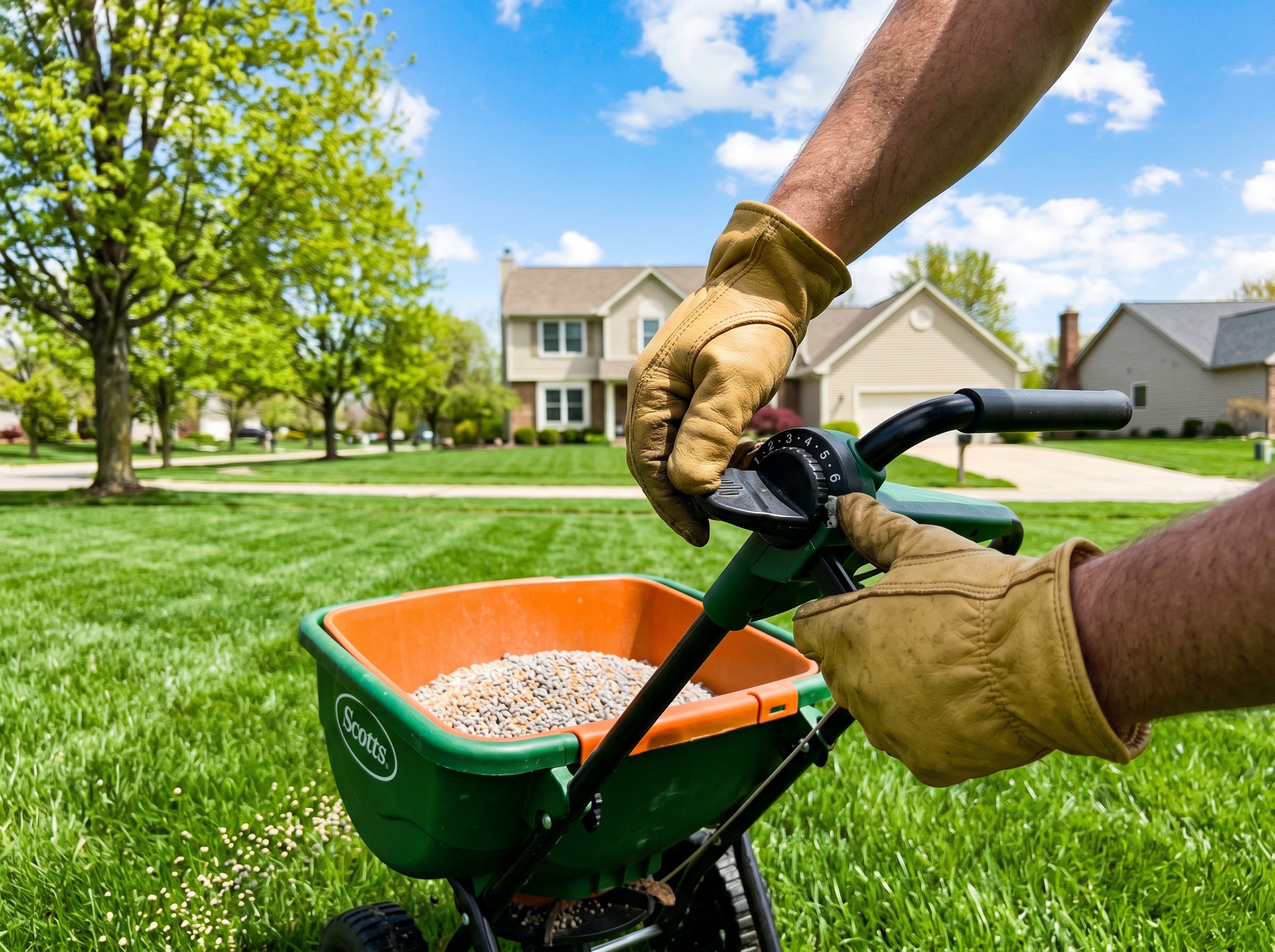
Walking speed and spreader settings dramatically affect how much fertilizer actually reaches your lawn[7]. Always calibrate your rotary or drop spreader before each application, and apply in two perpendicular passes at half the recommended rate to ensure even coverage. Manufacturer guidelines for your specific spreader model are a useful starting point, but field calibration on your own turf is always more accurate.
Mow Before You Fertilize
Fertilize after mowing (not before) to reduce the risk of burning grass blades[7]. Water lightly after application if rain isn't expected within 24–48 hours to help nutrients move into the soil. Avoid applying to wet foliage, which can increase the risk of foliar burn with granular products.
The Bottom Line for Ohio Homeowners
A well-timed lawn fertilizer schedule is one of the highest-impact things you can do for an Ohio lawn. Focus your energy and fertilizer budget on the fall applications in September and November — that's where cool-season grasses like Kentucky Bluegrass and Tall Fescue do most of their growing and root-building[1]. Keep summer applications light or skip them entirely, and always start with a soil test from Ohio State University Extension to dial in exactly what your lawn needs.
Your action plan:
- Schedule a soil test this season through your local OSU Extension county office
- Mark your calendar: late April, early September, and early November are your non-negotiable fertilizer dates
- Choose slow-release nitrogen products for summer applications to protect against Brown patch
- Pair your April feeding with a pre-emergent — confirm timing with a soil thermometer at 2-inch depth targeting 50–55°F
Sources
- Ohio State University Extension — Turfgrass management, fertilization recommendations, soil testing resources, and cool-season grass guidance for Ohio homeowners
2. University of Illinois Extension — Cool-season turfgrass fertility management, grass type nutrition requirements, and Midwest lawn care best practices
3. Purdue University Extension — White grub identification, lawn pest management, and pre-emergent herbicide timing for cool-season lawns in the Midwest
4. University of Kentucky College of Agriculture — Brown patch and Dollar spot disease management in cool-season turfgrass under warm, humid conditions, and Tall Fescue lawn care
5. USDA Natural Resources Conservation Service — Nutrient management, fertilizer runoff prevention, and soil health best practices for residential and agricultural properties
6. Pennington Seed — Research and product guidance on fertilizer application rates, cool-season grass nutrition, and Fine Fescue and Tall Fescue lawn care
7. Michigan State University Extension — Spreader calibration techniques, pre-application lawn preparation, and fertilizer best management practices for cool-season turfgrass in the Great Lakes region
