Quick Answer
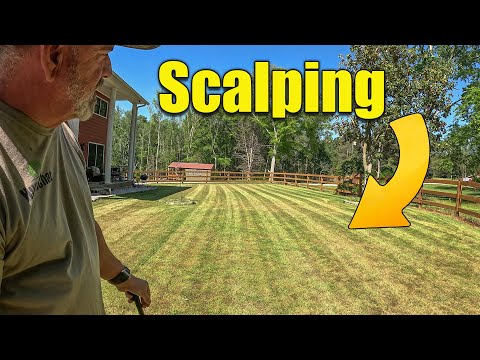
Lawn scalping involves cutting warm-season grasses like Bermuda and Zoysia down to half your normal cutting height in spring to remove dead brown material and promote healthy new growth.
Key Takeaways
- Scalp warm-season grasses to half your normal cutting height in early spring
- Don't worry about cutting too short - Bermuda and Zoysia have deep root systems that can handle aggressive cutting
- Follow scalping with light, frequent fertilizer applications rather than heavy single treatments
- Apply pre-emergent herbicide and fertilizer on the same day after scalping
- Use small particle-size fertilizers that hide in thatch for better distribution
Why Spring Scalping is Essential for Warm-Season Lawns
Spring lawn scalping might seem intimidating, but it's one of the most important tasks for maintaining a healthy Bermuda or Zoysia lawn. This aggressive cutting technique removes the accumulated dead, brown material that builds up at the base of grass blades over time.
Warm-season grasses develop brown stalks at their base as they grow throughout the season. Without proper scalping, these brown areas become visible every time you mow, especially on uneven terrain. The result is an unsightly lawn with brown streaks that no amount of regular mowing can eliminate.
The good news? Warm-season grasses are incredibly resilient. Bermuda grass roots can extend up to 30 inches deep, making these varieties nearly impossible to damage with aggressive spring cutting. Don't hesitate to cut short – your lawn will thank you for it.
Proper Scalping Technique and Timing
The golden rule for scalping height is simple: cut to half your desired maintenance height. If you normally maintain your lawn at one inch, scalp it down to half an inch. For lawns maintained at three-quarters of an inch, scalp down to three-eighths of an inch or even shorter.
Don't worry if you occasionally hit dirt while scalping – this won't harm your grass. The deep root system of warm-season varieties can easily handle this aggressive treatment. In fact, getting down to soil level ensures you've removed all the problematic brown material.
Timing is crucial for successful scalping. Wait until you see signs of active growth in spring, typically when nighttime temperatures consistently stay above 50°F. You'll know it's time when you notice rapid growth after spring rains.
For best results, use a sharp mower blade and work systematically across your lawn. The golf ball test is a good benchmark – after proper scalping, a golf ball should roll smoothly across your lawn surface.
Post-Scalping Fertilization Strategy
After scalping, your lawn needs proper nutrition to fuel rapid recovery and new growth. However, the key is using light, frequent applications rather than heavy single treatments.
Apply a balanced fertilizer with small particle size immediately after scalping. Micro-sized fertilizer particles hide better in the remaining thatch and provide more uniform distribution compared to larger granules. This is especially important since larger particles can be 8 inches apart, leaving grass blades without nearby nutrition.
Plan to fertilize every 3-4 weeks during the growing season with light applications. This approach is superior to heavy quarterly treatments because:
- Spring thunderstorms can wash away heavy fertilizer applications
- Shorter grass after scalping makes fertilizer more mobile
- Consistent light feeding promotes steady, healthy growth
You can safely apply pre-emergent herbicide and fertilizer on the same day after scalping. This timing maximizes the effectiveness of both products.
Watering and Recovery Care
Proper irrigation after scalping and fertilizing ensures your lawn recovers quickly and reaches its full potential. Even if you've received recent rainfall, additional watering helps activate fertilizer and promotes rapid grass recovery.
Use short, frequent watering cycles rather than long, deep watering sessions immediately after treatment. Ten-minute cycles once or twice daily work well to gradually move fertilizer down to the root zone without causing runoff.
This approach allows fertilizer to slowly dissolve and reach the roots where it's needed most. Continue this watering pattern for the first week after scalping, then transition to your normal irrigation schedule.
Remember that scalped lawns may look rough initially, but warm-season grasses recover remarkably quickly with proper care. Within 2-3 weeks, you'll see vigorous new growth that's healthier and more attractive than before scalping.
The effort invested in proper spring scalping pays dividends throughout the growing season with a thicker, more uniform lawn that maintains its color and appearance even under stress.